
Roughly one in three people who complete an executive health screening leave knowing about a condition they didn't know they had, most often a cardiovascular warning sign. That's why a busy professional who feels fine can still need a smarter look at heart risk.
A lot of executives in Delaware and nearby Pennsylvania or Maryland are in that exact spot. Work is demanding, sleep gets pushed, travel and meals are irregular, and a standard annual physical can look reassuring even when hidden risk is building.
Table of Contents
- The Hidden Risk in High Performers
- Understanding Executive Health Programs
- Core Components of Cardiovascular Assessment
- From Data to Actionable Insight
- Avoiding the Testing Trap
- Preparing for Your Clinical Visit
The Hidden Risk in High Performers
A Wilmington partner who never misses a meeting, a Lewes founder who still bikes on weekends, a Rehoboth physician who keeps a packed schedule, all can share the same blind spot. Feeling capable is not the same thing as being free of cardiovascular risk, because early atherosclerosis, masked hypertension, and metabolic changes often stay quiet for years.
That is why executive health screening exists as a deliberate search for what routine visits can miss. In one executive program, roughly one in three screened adults learned about an unrecognized condition, often a cardiovascular issue or an early lesion found on imaging, while another program reported 80% of participants were unaware of conditions discovered during their exam. Those numbers are a reminder that “I feel fine” is not a reliable risk assessment.
Practical rule: symptoms are a late signal, not an early one, especially in cardiovascular prevention.
A busy adult who has coasted on normal office blood pressure or a generic cholesterol panel can still carry subclinical disease. That's the logic behind a physician-led executive health program, it tries to surface hidden problems before they become disruptive, and then turns the findings into prevention, not panic.
Family history and heart disease screening becomes especially important here, because family history can shift the meaning of an otherwise ordinary test result. In preventive cardiology, context matters as much as the number.
Understanding Executive Health Programs
Executive health programs didn't start as luxury add-ons. One historical account traces preventive executive health back to 1913, when the Life Extension Institute launched a preventive initiative for corporate leaders, and by 1919 more than 150 companies, including Standard Oil of New York, were already offering executive physicals (history of executive health programs-of-executive-health-programs-in-america)). That history matters because it shows the model was built around early detection for high-responsibility workers, not around symptoms alone.
A modern executive health program is best thought of as a coordinated diagnostic day, not a rushed checkup. It combines history, exam, imaging, biomarkers, and physician interpretation into one coherent risk picture, which is very different from the fragmented “one issue at a time” style many people get in primary care.
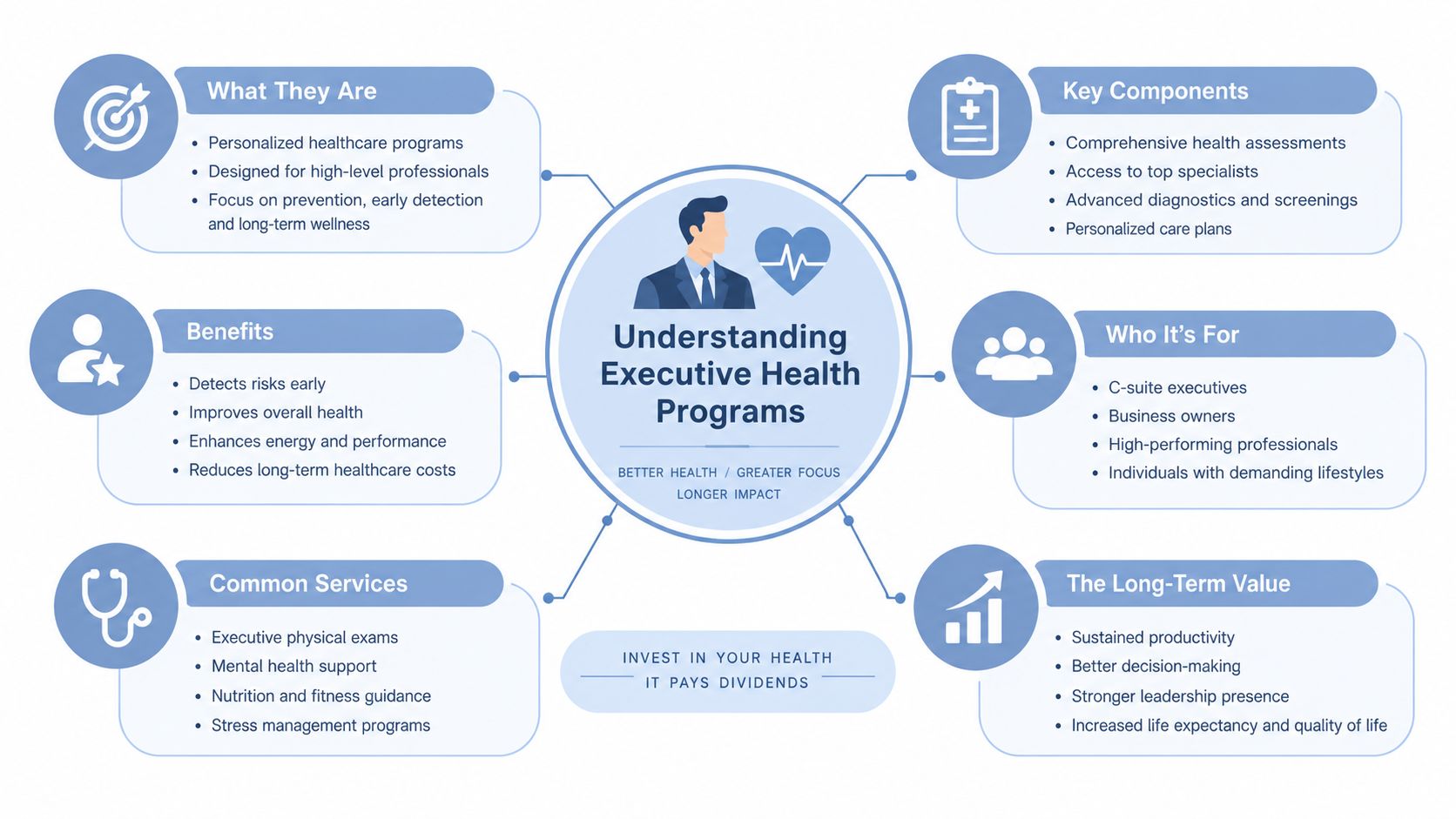
What makes the model different
A standard physical often checks whether something is obviously wrong today. An executive program asks a different question, which risks are already present, but not yet causing symptoms? That's a more useful question for adults in their 40s, 50s, and early 60s, especially when work pressure, travel, and family obligations make prevention easy to postpone.
The structure also respects time. Instead of scattered appointments, an executive program gathers the important data in one place, then has a physician synthesize it. For a preventive cardiology practice, that synthesis is the point, because raw test results don't protect anyone until they're translated into action.
Core Components of Cardiovascular Assessment
The heart of executive health screening is not “more testing.” It's better testing for the right profile. The main tools have different jobs, and understanding those jobs keeps the program useful instead of random.
Coronary calcium, lipids, and blood pressure
Coronary artery calcium, or CAC, is a decision tool, not a routine trophy scan. The American Heart Association says CAC is most technically useful in asymptomatic adults when 10-year ASCVD risk is borderline or intermediate and treatment decisions are still uncertain, and it's not recommended as routine screening in very low-risk or very high-risk adults because it usually won't change management (AHA CAC guidance). In intermediate-risk adults, a CAC score above 100 supports starting or considering statin therapy, while a score of 0 can justify deferring statins in selected people, with repeat assessment in 5 to 10 years if it would change care (ACC summary).
Advanced lipid phenotyping adds another layer. Lp(a) should be measured at least once in every adult's lifetime for ASCVD risk assessment, and apoB better reflects the burden of atherogenic particles in people with diabetes, hypertriglyceridemia, cardiovascular-kidney-metabolic syndrome, or established ASCVD (AHA Lp(a) guidance). That matters because LDL-C alone can miss risk that apoB and Lp(a) make visible.
Blood pressure also deserves out-of-office measurement. Ambulatory blood pressure monitoring diagnoses hypertension at an average 24-hour BP of at least 130/80 mm Hg, a daytime average of at least 135/85 mm Hg, or a nighttime average of at least 120/70 mm Hg (ABPM review). Home and ambulatory thresholds are lower than office readings because office values can miss masked or nocturnal hypertension (AAFP summary of guideline tables).
How the pieces fit together
A useful executive cardiovascular workup often combines imaging, biomarkers, and blood pressure context. Standard lipid panels and office vitals still matter, but they're only the starting point.
| Test Name | Clinical Purpose | Best For |
|---|---|---|
| Coronary artery calcium score | Reclassifies risk and shows subclinical atherosclerosis | Asymptomatic adults with borderline or intermediate risk |
| Lp(a) | Identifies inherited risk not seen on routine lipids | Adults with family history or unexplained risk |
| ApoB | Measures atherogenic particle burden more directly | People with diabetes, high triglycerides, or metabolic risk |
| Ambulatory blood pressure monitoring | Finds masked or nocturnal hypertension | Adults with normal office BP but suspicious risk profile |
For readers who want a deeper look at imaging options, advanced cardiovascular imaging is where CAC fits into a broader cardiology strategy. And for the metabolic side, HbA1c and metabolism basics is a useful companion resource because glucose risk often travels with cardiovascular risk.
Clinical shortcut: if a test result doesn't change a decision, it probably doesn't belong in the screening panel.
From Data to Actionable Insight
A stack of numbers isn't a prevention plan. The value of a physician-led executive health program is that someone trained in preventive cardiology explains what matters first, what can wait, and what should be repeated later.
That interpretation is where results become usable. A borderline CAC score may support more aggressive lipid-lowering, a zero score may support watchful deferral in a selected patient, and abnormal ambulatory blood pressure may trigger tighter blood pressure management even when the office reading looked acceptable. The point is not to chase every abnormality, but to prioritize the ones that change risk.
Why context changes the meaning of a result
A man with a strong family history, a raised apoB, and a CAC score above 100 is not in the same category as someone with a zero score and no meaningful risk enhancers. The numbers look simple on paper, but the treatment logic is not simple at all.
A cardiologist also looks for patterns. If blood pressure, lipids, sleep-related concerns, and metabolic markers all lean in the same direction, the plan may focus on one coherent set of changes instead of scattered advice. That's why a real consult feels different from a lab portal.
For readers who want help interpreting the sleep side of that broader picture, sleep biomarkers can help frame why sleep data sometimes belongs in a prevention conversation. Sleep doesn't replace cardiac testing, but it often affects how risk is read.
Results matter most when they lead to one clear next step, not five vague suggestions.
In practice, that next step could be a statin discussion, a repeat scan in a few years if the result would change management, a tighter blood pressure plan, or a more specific exercise prescription. The screening test is only the beginning; the plan is the product.
Avoiding the Testing Trap
More testing sounds reassuring until it creates false positives, unnecessary follow-up, and avoidable anxiety. That's the problem with broad, unfocused panels in asymptomatic adults, especially when the extra tests aren't likely to change care.
A large review of cardiovascular diagnostic testing noted that executive screening programs often include tests not recommended by guidelines for asymptomatic people, and a 2025 ACC/AHA performance-measures report reiterated that appropriate use reduces harm from unnecessary testing. That is the central tension in this field, precision is valuable, but indiscriminate testing can be low-value.
What targeted screening looks like
A thoughtful program matches the test to the question.
- CAC for the right person: useful when risk is borderline or intermediate and a statin decision is still uncertain.
- Lp(a) once, not repeatedly: helpful because it is genetically determined and mainly informs risk context rather than short-term change.
- ABPM when office readings are incomplete: useful when masked or nocturnal hypertension is plausible.
- Stress imaging only when it will alter care: not because more imaging feels safer, but because the result will affect management.
In this setting, physician judgment protects the patient from overtesting. A low-risk adult who has no symptoms and no meaningful risk enhancers usually doesn't need a broad menu of advanced scans. A higher-risk adult with family history or abnormal risk markers may benefit from a more detailed workup.
If the panel is built to find everything, it often finds too much.
Hosmane Longevity Center uses an evidence-based, cardiology-led approach to testing selection, with advanced diagnostics ordered to answer specific prevention questions rather than to fill a checklist. That style of care is the opposite of scattershot screening.
Preparing for Your Clinical Visit
A strong executive health visit starts before the appointment day. The best preparation is practical, not dramatic, bring your medication list, prior test results, family history, and a short list of the health concerns that keep coming up but never get resolved.

What to ask and what to bring
A good visit is more useful when the patient comes ready to discuss patterns, not just numbers. Questions worth asking include what the result means for risk, whether any follow-up test would change management, and which findings should be watched rather than treated.
- Bring family history details: relatives with early heart disease, stroke, diabetes, or lipid disorders can change the interpretation of your own results.
- Bring prior labs and scans: old information can prevent repeat testing and make patterns clearer.
- Bring your schedule constraints: travel, work demands, and meal timing matter because prevention plans have to be realistic.
- Ask about sequence: some markers are measured once, while others need repeat follow-up only if they would change treatment.
Busy professionals around Delaware often want an efficient visit that still feels thorough. That's exactly where a physician-led preventive cardiology appointment helps, because it turns a large amount of data into a plan that fits real life.
Individuals seeking a local option will find preventive cardiologist near me a useful starting point for understanding what a cardiology-centered prevention visit should include. In-person care is available at Hosmane Longevity Center's Lewes and Wilmington clinics, and testing is available to anyone, not only program members, when the clinical fit is right.
Hosmane Longevity Center offers physician-led executive health screening, advanced cardiovascular testing, and personalized preventive cardiology care for adults who want a clearer picture of heart risk. For readers in Lewes, Wilmington, Rehoboth, and nearby Delaware, Pennsylvania, and Maryland, the next step is a consultation at Hosmane Longevity Center to review family history, risk markers, and the right testing strategy for a busy life.