
A combined plan of the DASH eating pattern, weight loss, and exercise lowered systolic pressure by about 16.1 mm Hg and diastolic pressure by about 9.9 mm Hg in a meta-analysis of 24 randomized trials, a wider drop than DASH alone in that same analysis, according to an American Heart Association scientific statement on nonpharmacologic blood pressure care. That gap reframes any plan to lower blood pressure without medication. One food swap is not a full plan, and lifestyle change still has a ceiling.
Professionals in Lewes, Wilmington, Rehoboth, and nearby Pennsylvania and Maryland often want a data-driven path that survives travel and restaurant meals. The useful sequence is to rank each lever by the size of the measured change, check it against a home log, and stop the self-directed trial when the numbers, or the medical history, say a clinician should take over.
Table of Contents
- Which Lifestyle Changes Lower Blood Pressure Most
- Check Whether Lifestyle-Only Care Is Appropriate First
- How to Set Up a 7-Day Home Blood Pressure Baseline
- Cutting Sodium and Shifting Your Diet Day to Day
- Building Exercise, Sleep and Stress Habits Around a Busy Schedule
- Reading Your Results and Deciding When to Escalate
Which Lifestyle Changes Lower Blood Pressure Most
Measured effects sort from the largest average reduction to the smallest. Combined approaches lead. Single changes still matter, but they sit lower on the list.
| Lever | Typical systolic effect | Typical diastolic effect | Key evidence |
|---|---|---|---|
| DASH plus weight loss and exercise | about 16.1 mm Hg | about 9.9 mm Hg | 24-trial meta-analysis |
| DASH plus sodium reduction to 1,500 mg | about 8.9 mm Hg | about 4.5 mm Hg | DASH-Sodium trial |
| DASH-style eating | about 5.5 mm Hg | about 3.0 mm Hg | DASH controlled-feeding trial |
| Sodium below 2,000 mg/day | about 4.26 mm Hg | about 2.07 mm Hg | 2020 systematic review and meta-analysis |
| Advice-only sodium programs | about 1.1 mm Hg | about 0.6 mm Hg | Long-term randomized evidence |
Why stacked levers beat one change
The top row is large because diet, weight, and activity were changed together. A person who only swaps lunch still leaves sodium, weight, and inactivity untouched, so the weekly average barely moves.
In the DASH-Sodium trial, the DASH pattern at the low-sodium level lowered systolic pressure by an average of 8.9 mm Hg and diastolic pressure by 4.5 mm Hg versus a higher-sodium control diet, as summarized in an AHA statement on that feeding trial. Sodium reduction and the overall pattern acted as separate levers, not as the same change counted twice.
The original controlled-feeding DASH trial included 459 adults with and without hypertension. Compared with a control diet, that pattern lowered systolic pressure by 5.5 mm Hg and diastolic pressure by 3.0 mm Hg, according to the National Heart, Lung, and Blood Institute summary of DASH. Fruit, vegetables, and low-fat dairy went up. Saturated fat and total fat went down. The trial mattered because the whole pattern, not one nutrient, produced the change.
A 2020 systematic review and meta-analysis of randomized trials found that lowering sodium reduced systolic pressure by 4.26 mm Hg and diastolic pressure by 2.07 mm Hg. Each 50-mmol reduction in 24-hour sodium excretion was associated with a 1.10 mm Hg lower systolic pressure, per The BMJ. Advice-only programs produced smaller long-term reductions of about 1.1 mm Hg systolic and 0.6 mm Hg diastolic, which is why a written sodium audit beats a vague plan to use less salt, as noted in Cochrane evidence on high blood pressure.
Aerobic activity of at least 150 minutes a week, resistance training on two or more days a week, weight reduction, and better sleep are the remaining levers. Those trials measured them mainly in combination, so they don't get separate single-lever values here.
Replacing some saturated fat with unsaturated fat fits the same eating pattern. A clear starting point for that swap is using olive oil for cardiovascular health.
Practical rule: These figures are averages, not promised results. The response changes with starting pressure, adherence, how intensive the plan is, and kidney function.
Check Whether Lifestyle-Only Care Is Appropriate First
Lifestyle-only care can be reasonable for some adults whose readings sit just above target and who have no other relevant condition. It is the wrong first move when pressure stays high, when a reading is very high, or when another illness is already in the picture.
The 2025 U.S. hypertension guideline stresses that the response depends on starting pressure, adherence, intervention intensity, and the patient subgroup. Meditation or a single supplement is not equivalent to a full plan, and a prolonged medication-free experiment is unsafe for some people.
Three questions before any baseline
Answer these before the seven-day log in the next step.
- Is office pressure consistently at or above 140/90? A yes means a clinician review comes first.
- Is any of these present: pregnancy, diabetes, kidney disease, or signs of organ damage? Any one of them rules out a self-directed trial.
- Have chest pain, neurologic symptoms, or breathlessness shown up recently? Those symptoms need prompt assessment, not a diet experiment.
A yes to any question means booking clinical review before changing menus or training plans. A no to all three supports a measured lifestyle trial with a written baseline.
For professionals who travel, advanced cardiac testing can sit beside that decision. At Hosmane Longevity Center, led by Dr. Vinay Hosmane, testing can include 24-hour blood pressure monitoring, coronary artery calcium scoring, and Lp(a) and ApoB labs. Education and a personal plan still belongs with a clinician.
How to Set Up a 7-Day Home Blood Pressure Baseline
Home readings help show whether pressure is consistently high and whether a lifestyle plan is changing it. For the comparison to be useful, take each reading the same way and at consistent times.
The American Heart Association guidance on home monitoring recommends a validated upper-arm cuff and cautions against relying on cuffless devices such as smartwatches. Office and home readings use different thresholds: an office value of 140/90 mm Hg corresponds approximately to 135/85 mm Hg outside the office, according to the NHLBI threshold comparison used with out-of-office monitoring.
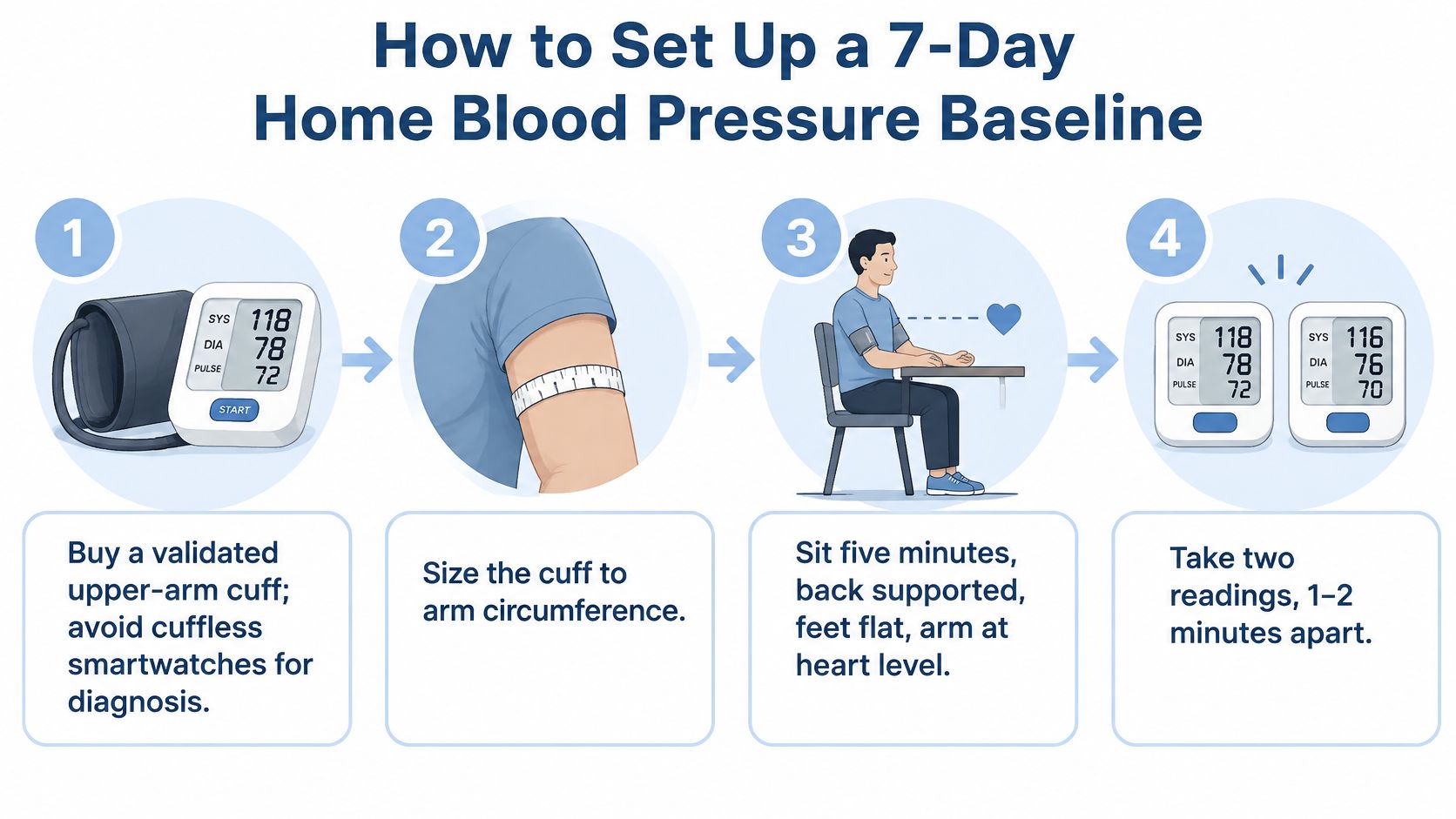
Seven steps and the reason for each
- Buy a validated upper-arm cuff. Wrist devices and cuffless watches are not reliable enough to diagnose high blood pressure or assess a plan. Note that wrist cuffs can be accurate if used correctly.
- Match the cuff to your arm circumference. A cuff that is too small can read high; one that is too large can read low.
- Sit for five minutes. Support your back, place your feet flat, and keep your arm at heart level. Posture can shift a reading before any lifestyle change takes effect.
- Take two readings one minute apart, morning and evening, for seven days. Repeating the measurement helps show whether a single high result was an outlier.
- Discard day 1 and average the remaining readings. The first day may be higher as you get used to the routine.
- Record sleep, alcohol, stress, and exercise beside each pair. These notes can help explain a daily rise or fall.
- Judge the weekly trend across all fourteen readings. A stressful meeting or late flight may affect a measurement; the full record puts that result in context.
What the average is for
A Wilmington attorney might record 148/92 in a clinic after a rushed morning, then average 136/84 at home across the retained days. The home mean gives a steadier baseline for assessing a diet or training plan than one reading taken after a hectic commute. For executives who travel or eat out, notes on travel days and meals can also help identify when a routine changes alongside the readings.
If the pattern remains unclear, a clinician can decide whether ambulatory monitoring is appropriate. That test adds readings during sleep and can identify nocturnal hypertension, which a seated morning check may miss. The seven-day log provides a consistent record to bring to that discussion.
Cutting Sodium and Shifting Your Diet Day to Day
A practical starting point is below 2,000 mg of sodium a day, about 5 g of salt. A label reading 800 mg of sodium is not a gram of salt in everyday terms, and confusing the two is how careful cooks overshoot.
The DASH-Sodium framework compared daily sodium levels of about 3,300 mg, 2,300 mg, and 1,500 mg, as summarized in this AHA review of those sodium levels. Lowering sodium can help lower blood pressure. The 1,500 mg level is a clinician-guided option, particularly for people with kidney disease, heart failure, heavy sweating, or medicines that affect potassium or fluid balance.
Where the sodium comes from
For people who travel often or eat out, the salt shaker is only a small part of the picture. Bread, sauces, cured meats, soups, restaurant entrées, and catered meals can all add sodium. A board dinner in Rehoboth can pass 2,000 mg before dessert if soup, a roll, and a glazed protein are served together.
Use a few repeatable menu choices:
- Choose fresh protein over cured. Turkey breast or grilled fish can replace deli meats and salted cured cuts.
- Season with herbs, citrus, or vinegar instead of bottled dressing. Check the bottle, since dressings can add sodium to an otherwise simple salad.
- Ask for sauce on the side and skip the bread basket when the entrée is already seasoned. Small requests can make restaurant meals easier to fit into a lower-sodium day.
Build the DASH pattern around vegetables, fruit, legumes, whole grains, low-fat dairy, and nuts, while choosing fewer processed foods. For a meal plan that fits personal health needs and a travel calendar, see what personalized nutrition means in practice. You can also find insights on balanced eating to help shape everyday meals.
People with kidney disease, heart failure, or medicines that affect potassium balance need clinician guidance before sharply increasing potassium-rich foods or switching to a salt substitute.
A menu change is easier to assess when sodium intake and missed days are tracked. Recheck the home blood pressure average about two to four weeks after changing staple foods, using the same cuff and checking at the same time of day.
Building Exercise, Sleep and Stress Habits Around a Busy Schedule
Diet trials can tightly control meals, while exercise, weight, and sleep are harder to standardize. These habits still matter: weight reduction matters whenever extra weight is present, and movement supports a broader lifestyle plan. The activity target is 150 minutes a week of moderate aerobic work, such as brisk walking or cycling, plus resistance training on two or more days. Spread activity across the week so it fits ordinary workdays.
One travel month, written as a schedule
A 52-year-old regional director who flies twice a month could split a 30-minute walk around two office meetings on in-town days, then fit a 20-minute hotel-room resistance session into travel days. Short sessions can add up toward the weekly target. A set of micro-workouts for busy days can help fill a hotel evening when the gym is closed and the next flight is early.
Keep a regular sleep window as schedules shift across time zones. Each Sunday, review the home blood pressure average alongside notes on steps, drinks, and bedtime. If readings improve during weeks with more walking, keep that routine. If they rise after late client dinners, look at the dinner pattern and record it alongside the other habits.
Sleep and alcohol as logged variables
Snoring, waking unrefreshed, or someone noticing pauses in breathing during sleep may point to a problem beyond a short night spent answering email. A clinician can order a home sleep study when those symptoms fit. Untreated sleep apnea can contribute to persistently high blood pressure, so discuss symptoms with a clinician and learn more about the link between sleep apnea and heart disease.
Stress and alcohol are hard to estimate from memory, so log them with each reading. Set a recovery block in the schedule and write down a drink limit, then compare those notes with the Sunday home average. That comparison can show whether a quieter week moved the numbers. If readings remain high, consider tightening the existing routine or seeking clinical assessment rather than adding another tracking app.
Reading Your Results and Deciding When to Escalate
Review the log after four to eight weeks, with a clear goal such as a 5 mm Hg drop in the weekly home average. Use the weekly average to pick the next step, since one morning reading can mislead.
| Weekly home average | What it suggests | Next step |
|---|---|---|
| Below 130/80 | At goal on the plan | Keep the routine and recheck monthly |
| 130-139 / 80-89 | Above target | Tighten sodium, activity, and sleep, then recheck in 4 weeks |
| 140/90 or higher | Persistent elevation | Book a clinician review |
| 180/120 or higher with symptoms | Possible emergency | Seek urgent care now |
How to read each row
An average below 130/80 suggests the current routine is working. Keep using the same cuff and follow the same sodium cap and activity plan. Recheck in a month before making further changes.
An average in the 130-139 / 80-89 range is above the home goal. Tighten sodium intake, protect the 150-minute activity week, and work on the sleep window. Repeat the seven-day average after four weeks.
With a proper home average of 140/90 or higher, lifestyle changes alone may not be enough. That is a sensible point to stop a medication-free experiment and arrange a clinician review. Bring the log, travel pattern, and details of any diabetes, kidney disease, or pregnancy.
A reading of 180/120 or higher with chest pain, neurologic symptoms, a severe headache, or shortness of breath calls for urgent care the same day. Symptoms need attention even when the weekly trend looks lower.
What a clinic visit adds
A clinic assessment can interpret the home log in context and determine whether additional evaluation is appropriate. For details on setting up the seven-day baseline, see the earlier section. A clinician may also consider supervised monitoring and advanced cardiac testing when they fit the situation. Any medication discussion should follow that broader assessment. Lifestyle changes can support blood pressure control, but they do not guarantee that a prescription will not be needed.
Readers seeking an assessment from a preventive cardiologist near me can bring the four-to-eight-week log to the visit. This article is general information, not individualized medical advice.
Hosmane Longevity Center describes a physician-led preventive cardiology and executive health program that pairs home blood pressure logs with advanced cardiac testing, nutrition planning, and exercise prescriptions suited to travel weeks. Adults can access testing outside the program as well. A consultation can help clarify whether lifestyle care should continue or clinical treatment should start.