
A parent's heart attack can turn an ordinary annual physical into an urgent question. An executive in Wilmington may feel healthy, exercise regularly, and have a reassuring standard cholesterol result, yet still wonder whether a father's early coronary event changes what should happen next. The useful question isn't whether heart disease appears in the family. It's which relative was affected, what happened, and at what age.
That distinction is the foundation of effective family history heart disease screening. Family history can justify earlier assessment, more complete lipid testing, and focused evaluation for inherited risk. It can't predict an individual outcome, replace a clinical examination, or determine a personal treatment plan by itself. Those decisions belong with a qualified clinician who can interpret the history alongside blood pressure, cholesterol, glucose, symptoms, lifestyle, and other medical factors.
For professionals in Lewes, Rehoboth, Wilmington, and nearby Pennsylvania and Maryland, the practical path is clear. Build a precise family record, identify whether the pattern suggests premature atherosclerotic cardiovascular disease or familial hypercholesterolemia, choose tests that answer specific questions, and create a follow-up plan that fits real work and travel demands.
Table of Contents
- Why Family History Changes Your Heart Screening Plan
- How to Build a Complete Family History That Guides Testing
- Which Heart Tests to Consider With a Family History
- When to Start Screening and How Often to Repeat It
- Turning Results Into a Clear Follow Up Plan
- Take the Next Step With Preventive Cardiology in Delaware
Why Family History Changes Your Heart Screening Plan
Consider a 48-year-old professional whose father had coronary disease at a young age. The patient's own LDL cholesterol looks acceptable, blood pressure is generally controlled, and there are no symptoms. A checkbox marked “positive family history” captures only a fraction of the clinical picture. It doesn't show whether the father had a heart attack, bypass surgery, or another condition, and it doesn't reveal whether other close relatives were affected.
Family history is a strong risk marker because inherited biology can influence lipid particles, vascular function, blood pressure, inflammation, and other pathways involved in cardiovascular disease. The relationship is especially important when a first-degree relative experienced premature disease. According to a review in Canadian Family Physician on family history and cardiovascular risk, offspring of parents with premature cardiovascular disease have about a 60% to 75% increased risk, while siblings have about a 40% increased risk.
The number of affected relatives and their ages matter. A parent affected early sends a different signal from a distant relative diagnosed much later in life. Several early events across parents and siblings may justify a more intensive review than one incompletely documented event.
The history must become clinically useful
A clinician needs more than “heart disease runs in the family.” The useful record identifies:
- Relationship: parent, sibling, child, or another relative.
- Age at onset: the age at a heart attack, coronary procedure, stroke, or diagnosis.
- Event type: coronary disease, stroke, peripheral arterial disease, sudden death, or another cardiovascular diagnosis.
- Treatment history: stents, bypass surgery, cholesterol medication, or genetic testing.
- Pattern: whether multiple biological relatives were affected.
This information helps distinguish an inherited risk signal from a vague family impression. It also helps determine whether the next step should remain with routine prevention or include advanced biomarkers, imaging, genetic counseling, or outreach to relatives.
Practical rule: A family history should change the quality of the conversation before it changes the number of tests.
A standard lipid panel remains useful, but it may not show all inherited risk. An ApoB test overview can help explain why the number and type of atherogenic particles deserve consideration when LDL cholesterol doesn't fully reflect the broader risk picture.
This article provides education, not individualized medical advice. A preventive cardiology consultation is appropriate for anyone with a strong or uncertain family pattern, particularly when a first-degree relative had premature cardiovascular disease. Hosmane Longevity Center uses a calm, evidence-based approach to connect family information with testing and prevention planning, without promising to reverse disease or guarantee an outcome.
How to Build a Complete Family History That Guides Testing
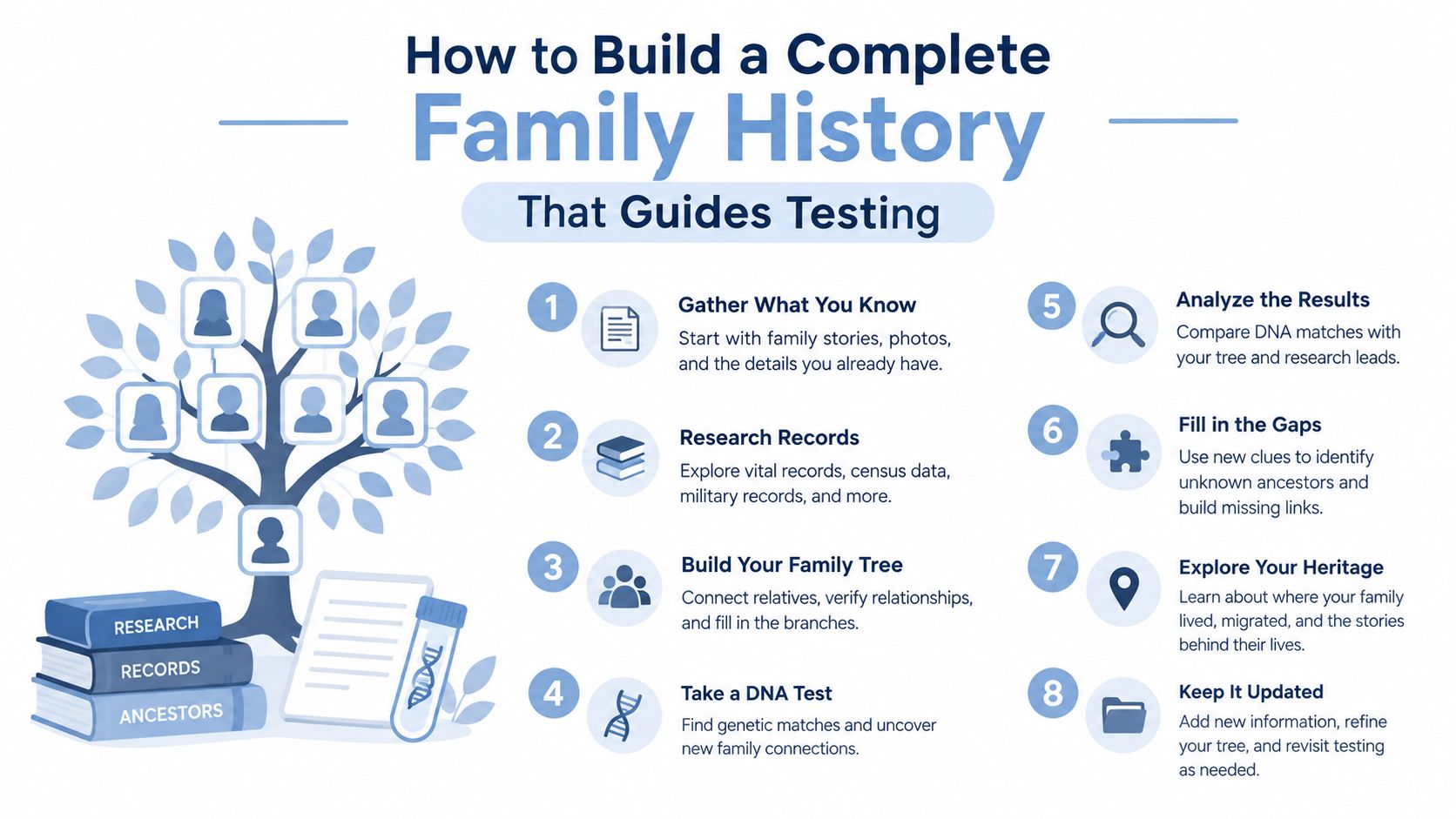
A useful family history is assembled, not guessed. The most efficient approach is to start with biological first-degree relatives and then expand outward when the pattern remains unclear. Records, old procedure reports, medication lists, and conversations with relatives can all improve accuracy.
Begin with a simple family map. Record each parent, sibling, and child, then add grandparents, aunts, and uncles when information is available. Mark whether each person is living, their current age or age at death, and any known cardiovascular diagnoses.
Ask questions that produce dates and diagnoses
Broad questions often generate vague answers. Specific prompts work better:
- Who had the event? Identify the biological relationship and whether the person was on the maternal or paternal side.
- What exactly happened? Ask about a heart attack, coronary stent, bypass operation, stroke, peripheral arterial disease, heart failure, or sudden unexplained death.
- How old was the person? Capture the age at the first event, not only the age at diagnosis or current age.
- Was the diagnosis confirmed? Distinguish a documented coronary event from a general statement that someone had “heart problems.”
- Were cholesterol levels unusually high? Ask whether the relative required long-term lipid treatment or was evaluated for familial hypercholesterolemia.
- Were multiple relatives affected? Count affected biological relatives and note whether events occurred across generations.
- Were there related conditions? Record high blood pressure, diabetes, kidney disease, or other conditions that may shape the overall assessment.
- Are records available? Look for discharge summaries, procedure records, medication histories, or genetic test results.
Age of onset deserves particular attention. Reviews have found that family-history records often omit both the affected relative and the age at onset, which weakens risk stratification. The same literature summarizes historically low screening uptake among relatives in some European cohorts, including about 5.6% to 9.3% of children, 10.5% to 18.6% of siblings, and 15% to 22% of first-degree relatives screened for risk factors, as reported in this review of family history and cardiovascular prevention.
Bring a concise record to the appointment
A one-page summary is more useful than a long, unstructured narrative. Include names or relationships, ages, event types, known cholesterol concerns, procedures, medications, and the source of each detail. If the family history is unknown because of adoption, estrangement, early death, or limited records, state that clearly. Unknown information shouldn't be treated as reassuring information.
The clinician can then classify the pattern, identify missing facts, and decide whether the history raises concern for premature ASCVD or familial hypercholesterolemia. The objective isn't to collect every medical detail in the family. It's to gather the details that change screening decisions.
Which Heart Tests to Consider With a Family History
A parent who developed coronary disease early, a sibling with unusually high cholesterol, and a relative with a known inherited mutation do not create the same testing plan. The useful family-history signal is structured: which relative was affected, what age, and what event occurred. Those details determine whether to start with standard lipids, add inherited-risk markers, consider imaging, or arrange genetic evaluation.
No single test answers every question. Use each test for a defined purpose.
| Test | What It Reveals | When Family History Makes It More Relevant |
|---|---|---|
| Standard lipid panel | LDL cholesterol, HDL cholesterol, triglycerides, and total cholesterol | Provides the foundation when a relative had early coronary disease or unusually high cholesterol |
| ApoB | The number of atherogenic lipoprotein particles | Adds information when LDL cholesterol may understate particle burden or inherited risk remains unclear |
| Lp(a) | An inherited lipoprotein associated with residual cardiovascular risk | Particularly relevant with premature ASCVD in the family, often as a once-in-a-lifetime assessment |
| Coronary artery calcium scoring | Calcified plaque in the coronary arteries | May refine prevention decisions for selected asymptomatic adults when overall risk and family history leave uncertainty |
| Carotid intima-media thickness | Structural features of the carotid artery wall | May contribute to vascular risk assessment, but does not directly measure coronary plaque |
| Genetic counseling and cascade testing | Whether a familial mutation or inherited disorder may be present | Relevant when familial hypercholesterolemia is suspected or an index case has a confirmed mutation |
Start with the lipid foundation, then look for what it misses
A standard lipid panel remains the first layer for many evaluations. ApoB measures the number of atherogenic particles carrying ApoB, while LDL cholesterol measures the cholesterol within LDL particles. That distinction matters when the family history suggests inherited risk but the standard lipid results appear less concerning than expected.
Lp(a) requires separate consideration. Guideline summaries describe a shift toward once-in-a-lifetime or broad adult screening, and they list a family history of premature ASCVD as a reason to measure it. The cardiovascular disease risk assessment guidance summary explains that inherited Lp(a) can contribute to residual risk even when LDL cholesterol is not dramatically high.
The practical recommendation is straightforward: obtain the standard lipid panel, then add ApoB or Lp(a) when the family pattern gives you a specific reason. Do not order every advanced marker automatically.
Use imaging to answer an imaging question
A coronary artery calcium scan evaluates calcified plaque in the coronary arteries. It does not measure every form of plaque or investigate every cause of chest symptoms. For an asymptomatic adult whose overall risk remains uncertain, a clinician can decide whether CAC scoring would change the prevention discussion.
Carotid intima-media thickness provides information about the carotid artery wall, but it is not interchangeable with coronary calcium scoring. Electrocardiography, stress echocardiography, ambulatory blood pressure monitoring, and other cardiovascular testing services answer different clinical questions. A family history alone does not justify ordering them all.
Recognize when the family pattern points to FH
Familial hypercholesterolemia, or FH, follows a distinct pathway. A review of familial hypercholesterolemia screening guidance reports support from several major societies for DNA testing when there is a family history of FH. Cascade screening becomes appropriate when a mutation is identified, allowing relatives to receive targeted evaluation.
The same review supports considering screening by age 5 when a parent has genetically, clinically, or phenotypically diagnosed FH. The American Heart Association and other groups support lipid screening in children ages 9 to 11 to identify FH early and extend evaluation to relatives.
Testing is available at Hosmane Longevity Center, including for people who are not executive health program members. The right approach is to match each test to a clinical question, family-history signal, and decision that could change prevention.
When to Start Screening and How Often to Repeat It
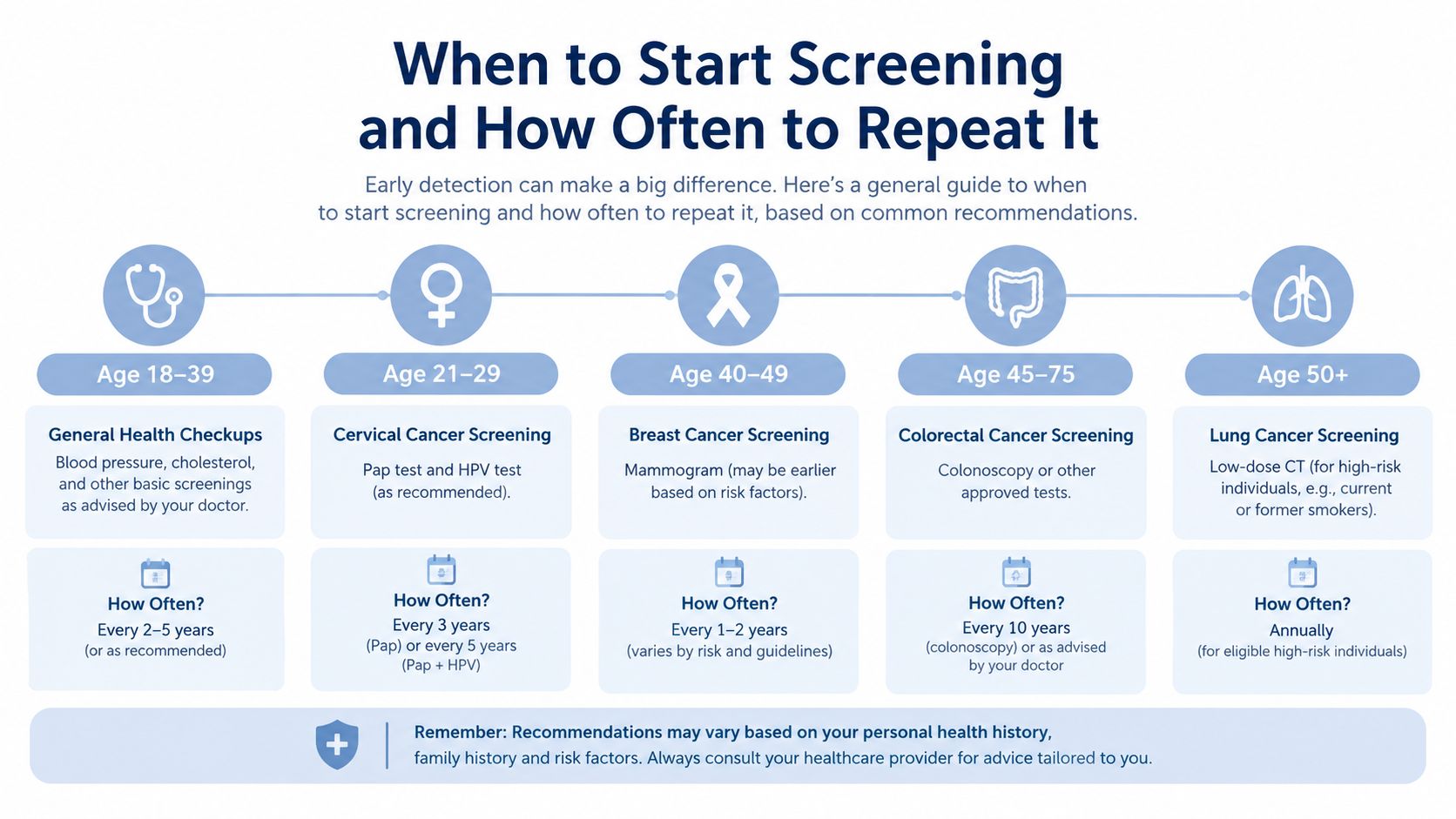
The right screening schedule depends on three details: which relative was affected, how old that person was when disease appeared, and whether the event involved premature coronary disease or a pattern suggesting familial hypercholesterolemia, or FH. A routine family history may call for standard preventive care. A parent with early coronary disease or several relatives with related findings should prompt earlier review and a more targeted testing plan.
A commonly used trigger for cascade screening is a first-degree relative with premature coronary disease before age 55 in men or 60 to 65 in women. That detail turns family history from a yes-or-no checkbox into a practical risk signal. It can support earlier assessment and screening of biological relatives, consistent with guideline reviews on FH and cascade screening.
Sequence the evaluation rather than ordering everything at once
Start with a careful family history, physical examination, blood pressure assessment, and foundational laboratory testing. The next test should answer a defined question. ApoB or Lp(a) may help clarify inherited lipid risk, while imaging is appropriate only when its result could change a prevention decision.
For adults, Lp(a) is often measured once because it is largely inherited. Repeat testing may be reasonable if the initial result is uncertain, the clinical situation changes, or the clinician needs to verify the measurement. Standard lipids, blood pressure, glucose-related markers, and other measures follow different schedules based on the findings and any treatment being used.
A sensible sequence: First define the family signal, then measure inherited biomarkers, then use imaging when it can resolve a remaining decision.
Children in the family may need evaluation before the patient. When a parent has diagnosed FH, guidance supports considering screening by age 5. AHA-supported pathways also support lipid screening in children ages 9 to 11, with testing extended to biological relatives when the results or family pattern justify it.
Plan follow-up around decisions, not calendar anxiety
Repeat a test when the result could change management or when a known risk factor requires monitoring. Automatic repetition of every test on the same schedule creates noise. Lipids may be checked after a treatment change, blood pressure may need home or ambulatory readings when office values vary, and imaging should be reconsidered only in light of the initial result and overall risk.
Professionals in Lewes, Wilmington, Rehoboth, and nearby PA or MD can organize screening through a preventive consultation instead of scattering appointments across offices. In-person visits at Hosmane Longevity Center clinics can include cardiovascular diagnostics interpreted directly by the cardiologist. No referral is required. Review the practice's cash-pay model and its Medicare and Medicaid limitations before scheduling.
Turning Results Into a Clear Follow Up Plan
A test result has value only when it changes a decision. A higher ApoB, high Lp(a), evidence of coronary calcium, or a pattern suggestive of FH should lead to a structured clinical discussion, not an isolated reaction to a number.
The physician's role is to place the result in context. That includes the family pattern, blood pressure, glucose status, smoking history, physical activity, body composition, sleep, symptoms, current medications, and the person's priorities. Risk modeling can help organize those variables, but it shouldn't replace clinical judgment.
Prioritize actions by impact and feasibility
A useful follow-up plan typically separates immediate decisions from longer-term monitoring:
- Clarify the finding: Confirm what the test measures and what it doesn't establish.
- Address modifiable risk: Review blood pressure, tobacco exposure, exercise, nutrition, sleep, and metabolic health.
- Discuss medication when appropriate: Consider preventive treatment based on the complete risk profile, not on family history alone.
- Choose monitoring: Set a rational schedule for repeat lipids, blood pressure readings, or other follow-up.
- Escalate only when indicated: Reserve additional imaging or specialist evaluation for a clear clinical reason.
A registered dietitian can translate laboratory findings into meals that work during travel and business dining. An exercise professional or physical therapist can help shape an individualized prescription around schedule, conditioning, orthopedic limitations, and recovery. Sleep evaluation may be relevant when symptoms or risk factors suggest it, while home or ambulatory blood pressure monitoring can clarify whether office measurements represent the usual pattern.
Extend the plan to biological relatives
A confirmed inherited condition affects more than one person. If testing identifies FH or another clinically relevant inherited pattern, the patient can discuss the result with biological first-degree relatives and encourage them to seek appropriate evaluation. That conversation should share the diagnosis, the reason screening matters, and the name of the clinician or genetic counselor who can explain next steps.
The goal isn't more data. It's a prioritized plan that tells the patient what matters now, what can wait, and who else may need evaluation.
Hosmane Longevity Center's preventive cardiology model brings physician interpretation, cardiovascular diagnostics, exercise planning, nutrition support, and monitoring into a coordinated plan. The approach emphasizes appropriate testing and avoids unnecessary procedures. It also accounts for demanding schedules, travel, and business meals, because a plan that cannot survive professional life won't remain useful.
Take the Next Step With Preventive Cardiology in Delaware
A strong family history deserves more than a checkbox and less than panic. The most useful process is structured: document the relative and age of onset, identify the event, assess whether the pattern suggests premature ASCVD or FH, select tests that answer specific questions, and schedule follow-up around the findings.
The basic lipid panel remains important, but it may not be the end of the evaluation. ApoB can clarify atherogenic particle burden, Lp(a) can identify an inherited source of residual risk, imaging can show selected evidence of subclinical disease, and cascade testing can help identify relatives who may benefit from earlier screening.
That approach suits executives and professionals who want decisions grounded in data rather than broad assurances. Preventive cardiology isn't about ordering every available test. It's about finding the smallest set of appropriate assessments that can meaningfully clarify risk and guide responsible action.
In-person evaluation is available in Lewes and Wilmington without a referral. On-site cardiovascular diagnostics are interpreted directly by the cardiologist, with results placed in the context of the patient's broader health and family record. The executive health program is one pathway for evaluation, while advanced cardiac testing is also available to people who aren't program members.
A consultation with Dr. Vinay Hosmane can help determine which aspects of family history deserve attention and which tests, if any, are clinically appropriate. The practice follows a cash-pay model, so prospective patients should review service details and payment considerations before arranging care.
Hosmane Longevity Center offers physician-led preventive cardiology, family-history review, advanced lipid testing, cardiovascular imaging, and structured follow-up for adults seeking proactive heart care. Visit Hosmane Longevity Center to request a consultation in Delaware and discuss a screening plan built around the family history, not just the checkbox.