
Popular advice says a normal LDL cholesterol result means the heart risk picture is under control. That advice is incomplete. In preventive cardiology, the more useful question is whether the bloodstream is carrying too many atherogenic particles, because that is what drives plaque exposure over time, especially when standard cholesterol numbers look reassuring but the biology underneath does not.
For executives and professionals who want a more exact view of risk, the ApoB test is often the next logical step. It does not replace clinical judgment, imaging, or the rest of lipid evaluation, but it often changes what gets discussed, what gets monitored, and whether treatment should stay steady or intensify.
Table of Contents
- Why Standard Cholesterol Panels Miss Hidden Risk
- Understanding the ApoB Test and Particle Count
- Interpreting Your ApoB Results and Risk Thresholds
- How ApoB Changes Preventive Cardiology Treatment Plans
- Advanced Cardiac Testing at Hosmane Longevity Center
- Taking Control of Your Cardiovascular Longevity
Why Standard Cholesterol Panels Miss Hidden Risk
A standard lipid panel is a useful starting point, but it can miss the part of the story that matters most. LDL-C measures the cholesterol mass inside particles, not the number of particles traveling through the blood. Plaque exposure is driven by particles, not just by the amount of cholesterol they carry.
That gap shows up when LDL particles are small and dense, or when triglycerides are high. LDL-C can look acceptable while apoB remains high. The 2024 AHA scientific statement notes that apoB improves residual-risk assessment in these settings and can outperform LDL-C for ASCVD prediction when LDL-C and apoB do not line up, particularly with high triglycerides or small dense LDL particles (AHA scientific statement).
Practical rule: a reassuring LDL-C value is not the same thing as low particle burden. If the metabolic context suggests discordance, apoB deserves attention.
Clinicians use apoB when the standard panel does not fit the clinical picture. A person can have a respectable LDL-C number and still carry a particle load that better explains residual risk. For highly engaged adults in Delaware and nearby Pennsylvania or Maryland, that distinction often changes the conversation from “numbers look fine” to “risk is better characterized.”
The difference matters in preventive decisions too. A standard panel may be enough for some low-risk adults, but it is less informative in people with mixed lipids, metabolic syndrome, or a strong family history. The 2018 AHA/ACC guideline treats apoB as a risk-enhancing factor and specifically flags triglycerides of ≥200 mg/dL as a relative indication to measure it, because LDL-C may understate atherogenic burden in that setting (2018 AHA/ACC guideline).
For readers who want a broader preventive framework, the clinic's educational material follows the same approach, starting with the basics and moving toward more complete risk modeling at Hosmane Longevity Center's blog.
Understanding the ApoB Test and Particle Count
The easiest way to think about apoB is as a headcount. Each atherogenic lipoprotein particle carries exactly one apoB molecule, so the blood level of apoB approximates the total number of circulating atherogenic particles rather than the cholesterol mass sitting inside them. That is why apoB gives a different kind of information than LDL-C.
Traffic rather than cargo
A helpful analogy is traffic. LDL-C tells you how much cargo is moving. ApoB tells you how many vehicles are on the road. If there are too many cars entering a crowded tunnel, the risk is congestion, even if some cars carry less weight than others. Arteries work the same way. More atherogenic particles mean more opportunities to enter the arterial wall and contribute to plaque.
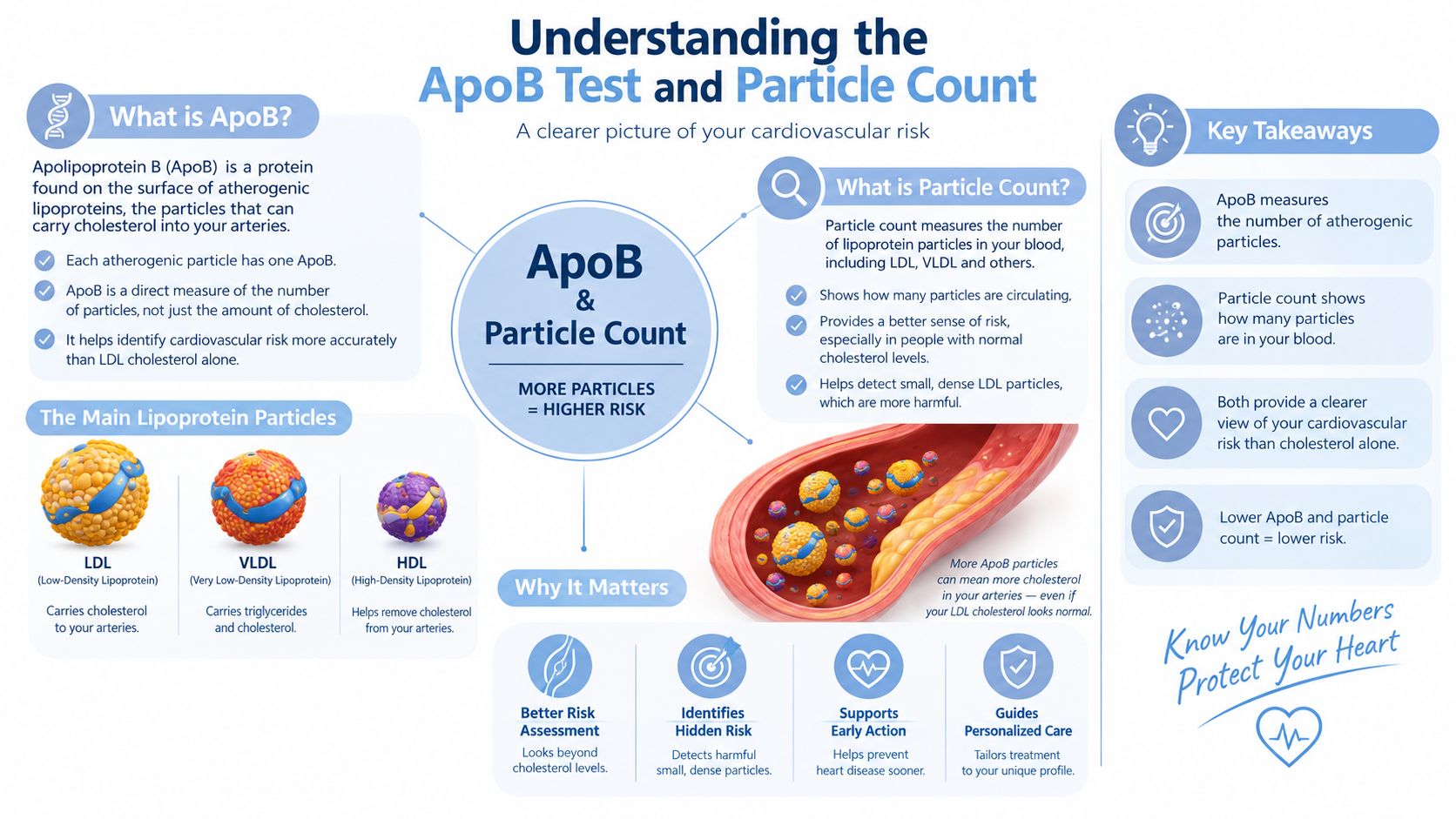
That is why apoB can be so useful when LDL-C and actual risk do not match. Two people can share the same LDL-C value and still have different particle counts. The person with more particles has more arterial exposure, even if the cholesterol mass looks similar on paper.
Why the test changes interpretation
The test is most valuable when clinicians need to know whether the atherogenic load is controlled. It helps explain why a patient who has already made strong diet or medication changes may still need closer follow-up if the particle burden remains high. It also helps make sense of patterns seen in insulin resistance, high triglycerides, and mixed dyslipidemia, where LDL-C can understate the issue.
ApoB is not a philosophical upgrade over LDL-C. It is a more direct measurement of how many atherogenic particles are circulating.
That directness is the reason the test is increasingly used in preventive cardiology. It gives physicians a better read on the biology that drives arterial exposure, and it does so in a way that fits practical treatment conversations. For adults trying to make sense of executive-health labs, that clarity is often the difference between vague reassurance and a concrete plan.
Interpreting Your ApoB Results and Risk Thresholds
ApoB becomes clinically useful once the number is tied to the clinical picture. A higher value means more atherogenic particles are circulating, so the question is not just whether the lab is abnormal, but whether it matches the rest of the risk profile and should change what comes next.
What those thresholds mean in practice
ApoB is most helpful when LDL-C looks acceptable but particle burden still seems high. That happens in mixed lipid patterns, family history, insulin resistance, and other settings where the standard panel can understate exposure. In those patients, apoB helps separate reassurance from real residual risk.
The triglyceride trigger matters for the same reason. High triglycerides often travel with LDL-C and apoB discordance, so the usual cholesterol panel can look less concerning than the underlying particle count. In that setting, apoB is a practical risk marker, not just a lab detail.
Here is the most useful way to think about the numbers:
| ApoB Level | Clinical Context | Guideline Implication |
|---|---|---|
| ≥130 mg/dL | Higher-risk primary prevention range | Supports a more serious statin discussion and closer risk refinement |
| Triglycerides ≥200 mg/dL | Relative indication to measure apoB | Helps detect LDL-C underestimation of particle burden |
| apoB and LDL-C discordance | Mixed or metabolic lipid patterns | ApoB may better reflect true atherogenic exposure |
The main interpretation is straightforward. A borderline or high apoB does not automatically mean medication is required, but it does mean the clinician should ask whether current therapy is lowering particle burden. That distinction matters when the lipid panel looks “acceptable” on paper and the overall risk context does not.
What to do with a result
ApoB should change the next conversation, not end it. If the number is high, the next step may be tighter nutrition, weight loss, or exercise work, especially when the pattern suggests early metabolic dysfunction. If the patient already has established disease, diabetes, or persistent LDL-C and apoB discordance, the result usually pushes treatment planning toward more aggressive risk reduction.
Recent guidance has moved apoB closer to routine prevention, especially in people with CVD-KM syndrome, type 2 diabetes, high triglycerides, or established CVD. That is the practical value of the test. It helps clinicians decide whether they are treating cholesterol mass alone, or the particle burden that drives arterial exposure.
How ApoB Changes Preventive Cardiology Treatment Plans
The ApoB test matters most after the number comes back. If LDL-C has already been addressed, the question is whether residual particle burden still justifies a change in strategy. The 2026 ACC/AHA dyslipidemia update says apoB measurement can help guide treatment intensification in people with ASCVD, cardiovascular-kidney-metabolic syndrome, type 2 diabetes, or high triglycerides after LDL-C and non-HDL-C goals are reached.
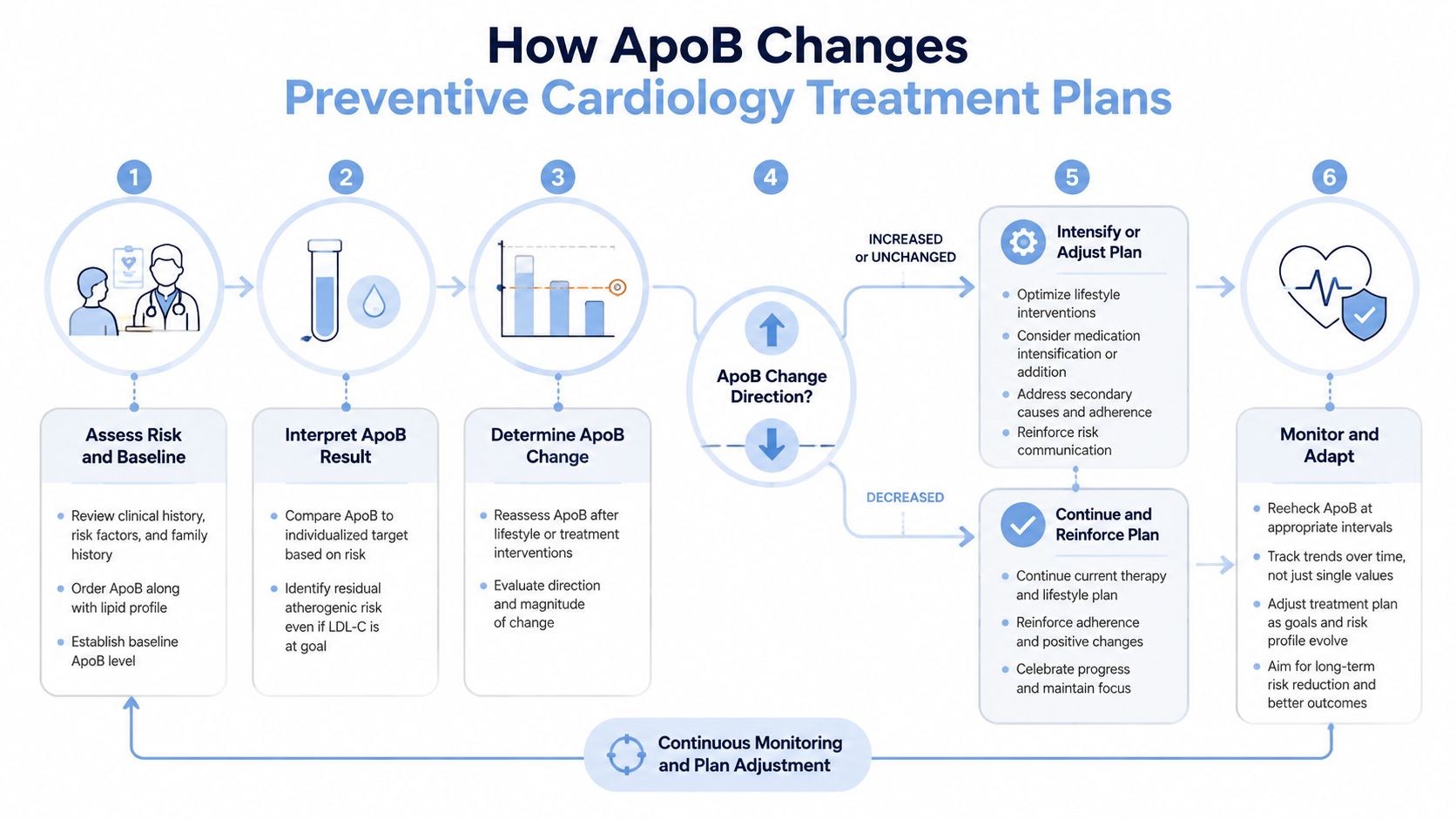
What changes after the number comes back
A high apoB result does not automatically mean medication should be escalated. In early metabolic dysfunction, the first move may be tighter nutrition, weight loss, or a more disciplined exercise prescription. When disease is already established, or when diabetes and LDL-C, apoB discordance persist, the result often pushes the clinician toward more aggressive lipid-lowering therapy.
That distinction matters because LDL-C can look better while apoB stays above target. Cholesterol mass has improved, but the number of atherogenic particles has not fallen enough. In preventive cardiology, that is a meaningful gap.
ApoB also changes follow-up. Patients with higher particle burden often need closer monitoring after statin initiation or other lipid-lowering therapy, because the goal is not only a better cholesterol panel, it is confirmation that particle burden is moving in the right direction. Contemporary literature also notes that even modest apoB, LDL-P mismatches can track with higher cardiovascular event risk, which is why apoB is increasingly used as a monitoring target rather than a one-time screening tool (PubMed review).
If LDL-C looks controlled but apoB does not, the treatment conversation is not finished.
For adults who want a structured plan, the practical question is whether lifestyle alone is enough, whether medication should enter the discussion, or whether both are needed in sequence. A more detailed risk review is available through Hosmane Longevity Center's executive health program.
Advanced Cardiac Testing at Hosmane Longevity Center
Standard care often fragments risk into separate pieces. One clinician checks lipids, another orders imaging, and the patient is left to connect the dots. Preventive cardiology works better when biomarkers, imaging, and lifestyle context are reviewed together by one physician-led team.

At Hosmane Longevity Center, Dr. Vinay Hosmane and the care team combine advanced lipid and inflammatory biomarkers, including ApoB and Lp(a), with cardiovascular imaging and other cardiac testing to build a more complete risk profile. That matters because a marker like apoB is most useful when it is interpreted alongside the rest of the clinical picture, not in isolation.
How the model differs from routine screening
The center's approach includes advanced cardiovascular imaging such as CAC, CIMT, stress echocardiography, abdominal aortic ultrasound, and exercise ABI, along with cardiac and vascular monitoring and sleep and lab diagnostics. The practical advantage is coherence. A single clinician can decide whether the data point toward hidden plaque burden, ongoing metabolic risk, or a need for closer surveillance.
ApoB testing is available as part of that approach and can also be arranged for anyone seeking a more precise lipid assessment, not just executive health program members. That matters for adults who want advanced cardiac testing without waiting for a problem to become obvious. The value is in earlier clarification, not in dramatic claims.
The clinic also aligns nutrition, exercise prescription, physical therapy, and medical management under one plan. That makes sense for high-demand adults whose schedules leave little room for trial and error. A result is only useful if it leads to a workable next step, and that is where physician interpretation matters most.
For patients who want a physician-led assessment of particle-level risk, the testing pathway is outlined at Hosmane Longevity Center's testing page. The emphasis is not on more testing for its own sake. It is on the right testing, interpreted in context, so the prevention plan is grounded in biology rather than guesswork.
Taking Control of Your Cardiovascular Longevity
ApoB changes the conversation because it shifts attention from cholesterol mass to atherogenic particle burden. For executives and professionals who want a clearer risk model, that shift matters. It often explains why someone with an acceptable LDL-C still deserves a more careful preventive strategy, especially when triglycerides, diabetes, metabolic syndrome, or family history are part of the picture.
The best use of apoB is not as a standalone number. It is as a decision-making tool that helps determine whether current care is enough, whether treatment should intensify, and whether additional imaging or follow-up is warranted. The most effective prevention plans are the ones that turn biomarker data into a sequence of concrete clinical choices.
Adults in Lewes, Wilmington, Rehoboth, and nearby Delaware, Pennsylvania, and Maryland communities can use that information to ask better questions at the right time. A detailed review is especially valuable when standard labs feel incomplete or when risk factors are stacking up.
Hosmane Longevity Center offers physician-led preventive cardiology, advanced lipid testing, and integrated cardiovascular risk assessment for adults who want more than a routine cholesterol panel. If ApoB, particle burden, and hidden risk are relevant to your health goals, visit Hosmane Longevity Center to schedule a consultation and discuss a personalized prevention plan.