A common scenario plays out in executive physicals across Delaware and nearby Pennsylvania and Maryland. A busy professional has a blood pressure reading in the office that looks acceptable, gets a quick reassurance, and goes back to meetings, travel, deadlines, and late dinners. Meanwhile, blood pressure may be running higher during the workday, staying high overnight, or failing to fall during sleep.
That gap matters because blood pressure isn't a fixed number. It behaves more like a daily rhythm. Stress, movement, meals, sleep, medication timing, and recovery all shape the pattern. A single clinic reading can be useful, but it can also miss the story that unfolds over the other twenty-three hours.
For adults who take prevention seriously, that raises a practical question: what is 24 hour blood pressure monitoring, and when is it worth doing? For many high-performing adults, the answer has less to do with one “high” or “normal” reading and more to do with seeing how pressure behaves in real life, especially at night.
24-hour ambulatory blood pressure monitoring, usually called ABPM, becomes valuable. It tracks blood pressure during work, commuting, meals, exercise, and sleep. That fuller picture can uncover hidden risk patterns that standard office checks often miss.
At a preventive cardiology practice such as Hosmane Longevity Center, the interest isn't just whether blood pressure crosses a line in the clinic. The larger question is whether the pattern suggests avoidable vascular strain over time. That's the kind of data-driven distinction many professionals want before problems become symptoms.
Table of Contents
- Introduction to 24 Hour Blood Pressure Monitoring for Proactive Heart Care
- What 24 Hour Ambulatory Blood Pressure Monitoring Is and How It Differs
- How 24 Hour Blood Pressure Monitoring Works During Your Day and Night
- Why Clinicians Recommend 24 Hour Monitoring and Who Benefits Most
- Understanding Your 24 Hour Blood Pressure Results and Nighttime Patterns
- How to Prepare for 24 Hour Blood Pressure Monitoring and Get Accurate Results
- Next Steps After 24 Hour Monitoring at Hosmane Longevity Center
Introduction to 24 Hour Blood Pressure Monitoring for Proactive Heart Care
A senior executive can leave an annual physical with a blood pressure number that seems reassuring, then spend the next week under deadline pressure, sleeping poorly, and never realize that the most important readings may be happening after midnight. That is the blind spot with routine blood pressure care. The office value may be acceptable while pressure stays high during the workday, remains high at night, or fails to drop during sleep.
For preventive cardiology, that overnight pattern matters more than many people realize.
Early ambulatory monitoring research changed how clinicians think about risk because outcomes tracked more closely with blood pressure measured during daily life than with a single office reading. Over time, that evidence also showed something even more useful for prevention. Nighttime blood pressure and the normal overnight "dip" often carry strong prognostic value, which is why modern reviews of ambulatory monitoring place so much emphasis on sleep readings and 24-hour averages (review of ambulatory blood pressure monitoring, prognosis, and clinical use).
Why proactive adults should care about the night shift
Blood pressure follows a rhythm. In healthy patterns, it usually eases down during sleep, much like a car engine idling lower once the highway drive is over. If that drop does not happen, or if pressure rises at night, the cardiovascular system may be working through its recovery window instead of resting.
That hidden pattern helps explain why a capable, health-conscious adult can feel well, stay active, and still carry more vascular risk than an office reading suggests.
For high-performing adults, the practical question is not only, "Is my blood pressure high?" It is also, "What is my average during the day, what is it during sleep, and does it fall overnight the way it should?" Those three pieces often shape better decisions about timing of treatment, the need for home monitoring, screening for sleep apnea, and how aggressively to approach prevention.
Who often benefits from a closer look
ABPM is often useful for adults who want a clearer answer than a clinic reading can provide, including:
- Professionals with inconsistent numbers: readings that vary across office visits, home checks, travel, or high-stress periods.
- Adults with strong family history: especially those who want earlier signal detection before blood pressure is obviously abnormal in clinic.
- People focused on prevention: adults already assessing lipids, metabolic risk, imaging findings, or sleep quality.
- Anyone with normal office readings but lingering concern: particularly if energy, sleep, stress load, or recovery seem out of proportion to a "fine" office result.
At Hosmane Longevity Center, the goal is not to label a reading as normal or high. The goal is to see whether the 24-hour pattern, especially the nighttime pattern, suggests quiet strain that deserves attention before it becomes disease.
What 24 Hour Ambulatory Blood Pressure Monitoring Is and How It Differs
A busy executive can have a perfectly acceptable office reading at 2 p.m. and still run high during the workday, stay high through the evening, or fail to fall during sleep. That is the gap ambulatory blood pressure monitoring, or ABPM, is designed to close.
24-hour ambulatory blood pressure monitoring is a portable test that measures blood pressure repeatedly across a full day and night while you live normally. At Hosmane Longevity Center, the test is performed with the Biobeat system: a wireless, medical-grade chest patch rather than a traditional arm cuff. The patch sits on the chest and records blood pressure automatically through the day and night, sending readings to a paired mobile app. There is no cuff to inflate, no tubing, and no monitor clipped to a belt, so readings continue through meetings, workouts, and sleep without interrupting them.
A clinic reading works like a photograph. ABPM works like a full-day recording. One snapshot can be useful, but it cannot show the pattern.
The difference between a snapshot and a full-day record
An office measurement captures blood pressure in one setting, at one moment, under one set of conditions. ABPM shows how pressure behaves during meetings, commuting, meals, exercise, evening recovery, and sleep. That matters because blood pressure is not static. It shifts with activity, stress, posture, timing, and the body's internal clock.
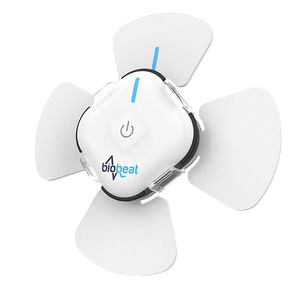
The Biobeat chest patch used for 24-hour monitoring at Hosmane Longevity Center. Image courtesy of Biobeat.
The monitor samples often enough to capture that pattern across waking hours and sleep. The recording also has to be usable. If too many readings fail, the study becomes less reliable.
What ABPM actually reports
ABPM gives several averages, not one isolated number:
- 24-hour average
- Daytime average
- Nighttime average
- Dipping pattern, which reflects whether blood pressure falls during sleep
For preventive cardiology, the nighttime values often carry the hidden signal. A person may look acceptable by office measurement and even by daytime average, yet still have a high sleep average or a reduced normal overnight drop. That pattern can change what a clinician does next, including whether to confirm hypertension, look more closely for sleep apnea, adjust medication timing, or follow blood pressure more closely over time.
The thresholds used for ABPM are also different from office thresholds. A commonly used review summarizes the usual cutoffs as a 24-hour mean of at least 130/80 mmHg, a daytime mean of at least 135/85 mmHg, and a nighttime mean of at least 120/70 mmHg (review of ambulatory blood pressure thresholds and risk). This is one reason ABPM should not be interpreted as if it were a stack of office readings. It answers a different clinical question.
How ABPM differs from home monitoring and consumer wearables
Home blood pressure monitoring is useful, but it depends on a person choosing when to measure. That usually means quiet daytime moments. ABPM collects readings automatically, including during sleep, which is exactly when many revealing patterns appear.
Consumer wearables add another layer of confusion. Many smartwatches and fitness bands estimate blood pressure, but they are not validated for diagnosis or treatment decisions. A medical-grade ABPM device is a different category. ABPM remains the clinical standard when the goal is to understand blood pressure across the full 24-hour cycle, especially the nighttime pattern that routine checks often miss.
The Biobeat patch has also been compared directly with an arterial line, the invasive catheter measurement used as the reference standard in hospital intensive care. In a 2025 preliminary validation study of 96 adults recovering from cardiac surgery, its readings tracked arterial-line pressure closely, with correlation coefficients of 0.96 or higher (Journal of Human Hypertension, 2025). The authors describe the results as preliminary and call for further study under current validation protocols for cuffless devices.
Practical rule: Home monitoring helps answer, "What is my blood pressure when I decide to check it?" ABPM helps answer, "What is my blood pressure doing across real life, especially during sleep?"
How 24 Hour Blood Pressure Monitoring Works During Your Day and Night
The patient experience is straightforward. The Biobeat patch is applied to the chest at the start of the test. After that, the person leaves the office and resumes a typical day.
Readings are taken automatically and quietly. Because there is no cuff squeezing the arm, there is nothing to pause for during the day and nothing to wake you at night. That matters, because nighttime readings are often the most revealing part of the study.
What a typical day with the monitor feels like
Most can work, attend meetings, drive, eat, and sleep with the device in place. The main adjustments are practical.
- Wearing the patch: keep it in place for the full recording, and follow the instructions you are given about water and exercise.
- During sleep: sleep as you normally would. Night readings are often the most clinically revealing, and the patch records them without waking you.
- During the day: continue normal routines unless given different instructions. A test is most useful when it reflects ordinary life rather than an unusually quiet day.
A simple diary often improves interpretation. Recording sleep time, wake time, exercise, unusual stress, symptoms, or medication timing helps the clinician match numbers to context.
What makes a study useful or inconclusive
ABPM is often described as superior, but that's only true when the recording is interpretable. If the patch loses good contact with the skin, readings fail, sleep is unusually short or disrupted, or too few measurements are captured, the study may be less useful or even inconclusive.
That nuance matters. Good preventive cardiology depends on good data, not just more data. The monitor, its placement, the recording quality, and the interpretation all shape whether the result changes management.
For readers exploring cardiovascular testing options, this kind of monitoring isn't limited to members of an executive health program. It can be ordered as a focused diagnostic test for anyone who needs a clearer blood pressure picture.
A low-quality ABPM trace can create false confidence or false alarm. The recording has to be technically sound before the numbers mean much.
Why Clinicians Recommend 24 Hour Monitoring and Who Benefits Most
A common executive health scenario goes like this. The office blood pressure is a little high during a rushed clinic visit, or it looks fine after a quiet morning, yet neither reading matches the person's real week. Clinicians recommend ABPM because treatment decisions are better when blood pressure is measured across normal work, travel, exercise, and sleep, not from a single snapshot.
The biggest reason is misclassification. Office readings can overstate risk in some adults and miss it in others. ABPM helps sort out whether the pressure burden is persistent, occasional, or concentrated at a time of day that the clinic never sees.
One of the best-known patterns is white coat hypertension, where blood pressure rises in the medical setting but is lower outside it. An earlier American Heart Association review noted that office and ambulatory readings often do not match, and it also outlined the ambulatory thresholds clinicians use to interpret those differences (AHA article on white coat hypertension and ambulatory equivalents).
For preventive cardiology, the more easily missed problem is often the opposite. A person can look acceptable in clinic and still run high blood pressure during work hours, during sleep, or both. That pattern matters because nighttime pressure is not background noise. It is closer to your body's overnight load, the period when blood pressure should usually ease down.
Patterns ABPM can reveal that office readings often miss
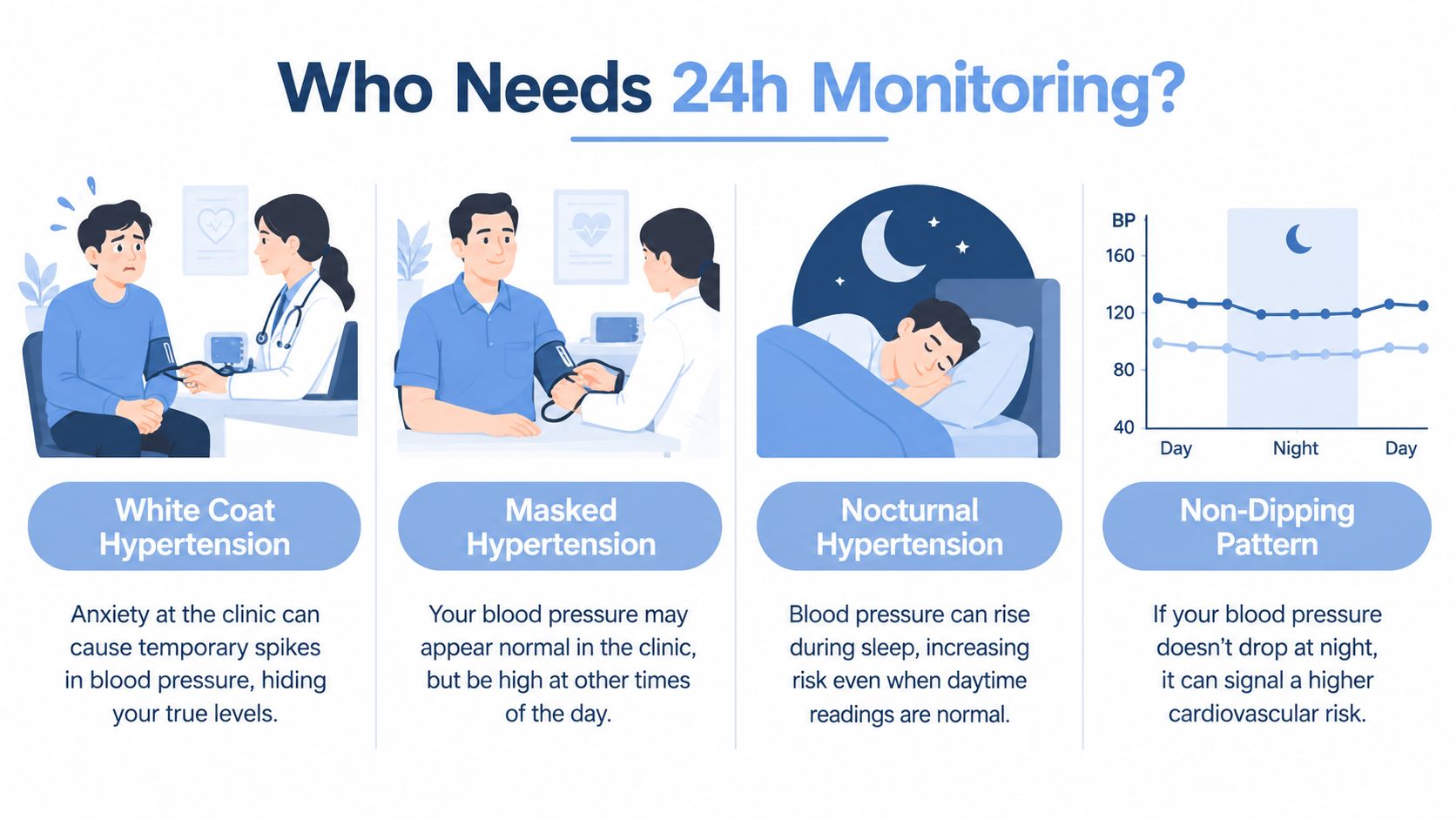
- White coat hypertension: high in the clinic, lower outside the clinic.
- Masked hypertension: normal in the clinic, high during usual daily life.
- Nocturnal hypertension: high blood pressure during sleep.
- Non-dipping pattern: blood pressure fails to fall normally overnight.
- Apparent resistant hypertension: readings seem difficult to control, and ABPM helps show whether the elevation is sustained or partly related to measurement setting.
Who benefits most
ABPM is especially useful for adults with borderline office readings, large visit-to-visit swings, suspected white coat or masked hypertension, treated hypertension that still seems inconsistent, or symptoms that do not fit the office number.
It is also highly relevant for high-performing adults with compressed schedules and uneven recovery. Long workdays, frequent travel, late meals, alcohol, poor sleep, and untreated sleep apnea can distort the usual day-night rhythm. In those settings, the nighttime reading and dipping pattern may explain risk better than a calm in-office measurement taken at 10 a.m.
That is the hidden signal many summaries skip. Clinicians are not only asking, “Is blood pressure high?” They are also asking, “Is it staying high at night, when it should be lower?” A normal daytime average with a blunted overnight dip can change how a preventive plan is framed, especially when it sits alongside family history, lipid abnormalities, or imaging findings. Adults building that broader picture often review advanced cardiovascular imaging in a prevention-focused evaluation because pressure burden and plaque burden frequently need to be interpreted together.
ABPM is not necessary for every patient. For the right patient, it replaces guesswork with a full-day pattern, and that pattern often matters most after dark.
Understanding Your 24 Hour Blood Pressure Results and Nighttime Patterns
A common scenario goes like this. An executive has a decent clinic reading, stays active, and assumes the story is reassuring. Then the 24-hour report shows blood pressure staying too high during sleep, or barely falling at all overnight. That hidden pattern often matters more than people expect.
ABPM reports are built around three averages. The 24-hour mean shows the total pressure load your arteries experience across the full day. The daytime mean reflects waking hours. The nighttime mean captures what happens during sleep, when blood pressure should usually ease down.
The thresholds that matter
Below is a simplified comparison of the thresholds commonly used in practice.
| Measurement Setting | Elevated Threshold | What It Reflects |
|---|---|---|
| Office blood pressure | 140/90 mm Hg | A clinic snapshot |
| 24-hour ABPM average | 130/80 mm Hg | Overall pressure burden across a full day and night |
| Daytime ABPM average | 135/85 mm Hg | Pressure during waking hours |
| Nighttime ABPM average | 120/70 mm Hg | Pressure during sleep |
These cutoffs are used because ambulatory readings and office readings are not interchangeable. A normal-looking office number does not always rule out excessive pressure exposure across the full day, and it says even less about what happens during sleep.
Why nighttime blood pressure changes the conversation
Nighttime blood pressure deserves special attention because sleep is supposed to be a recovery phase. In healthy physiology, pressure usually drops overnight. If daytime blood pressure is the stress test of your working hours, nighttime blood pressure is the audit of whether your system resets.
That is why clinicians look beyond a single average. A person can have a daytime pattern that looks only mildly abnormal, yet carry a more concerning nighttime burden. In prevention-focused care, that can affect how aggressively overall risk is interpreted, especially when other markers also suggest higher exposure. For example, a high blood pressure burden paired with an abnormal ApoB test for cardiovascular risk can point to a different level of concern than either finding alone.
What dipping means in plain language
During normal sleep, blood pressure usually falls by about 10 percent or more compared with daytime levels. That is called a dipping pattern. When the drop is smaller, absent, or reversed, the pattern may be described as non-dipping or reverse dipping.
A simple way to understand this is to picture the cardiovascular system like a company that needs an overnight maintenance window. If the machinery never gets that lower-pressure interval, wear can continue in the background even when daytime performance looks fine.
This pattern can show up in adults with poor sleep, late alcohol intake, untreated sleep apnea, chronic stress, shift work, or advanced vascular stiffness. It can also appear in treated hypertension when medication timing controls office readings but does not fully cover the night.
How to read the report without overreacting to one line item
A useful interpretation starts with a few practical questions:
- Is the 24-hour average high?
- Is the nighttime average high, even if the daytime average looks acceptable?
- Did blood pressure drop normally during sleep?
- Do the readings fit the person's sleep quality, symptoms, medication timing, and broader risk profile?
One reading matters less than the pattern.
That is the main value of ABPM. It turns blood pressure from a snapshot into a full-day movie. For high-performing adults, the nighttime scenes are often the ones that change preventive decisions.
How to Prepare for 24 Hour Blood Pressure Monitoring and Get Accurate Results
A good ABPM study is less about trying to have a "perfect" day and more about capturing your real day. For a busy executive, that matters. The goal is not to perform for the monitor. The goal is to show what your blood pressure does during meetings, commuting, exercise, meals, and sleep, especially during the hours when you are not paying attention to it.
The monitor works like a day-and-night flight recorder. If your routine is unusually calm, unusually stressful, or cut short by avoidable measurement errors, the recording becomes harder to interpret. That is especially important when your clinician is trying to understand nighttime pressure and whether you dip normally during sleep.
Practical steps before and during the test
- Dress normally: wear what you usually wear. There is no arm cuff, so sleeve fit does not matter.
- Take medications as directed: follow your usual schedule unless your prescribing clinician gives different instructions.
- Leave the patch in place: keep it on for the full recording period unless you are told otherwise. Gaps in the recording make it harder to interpret.
- Keep the day typical: work, commute, meals, and activity should be as close to normal as possible.
- Record timing that helps interpretation: note when you went to bed, woke up, exercised, felt symptoms, had unusual stress, traveled, or took medications.
- Ask about water: follow the instructions you receive about showering and swimming while wearing the patch.
- Sleep as usual: go to bed at your normal time and in your normal position, and note when you fell asleep and woke up.
Small details make a difference.
If you usually have coffee, ask whether to keep your routine unchanged or to limit it for that day. If you exercise late, or if alcohol is part of your evening routine, record the timing. Those details can help explain why a nighttime average ran high or why dipping was less than expected.
Common reasons studies become hard to interpret
Interpretation gets harder when the monitor misses too many readings or when the timing of sleep is unclear. Shift work is a common example. In that setting, "nighttime" on the report may not match your true sleep period unless it is documented carefully.
Travel can also distort the study. So can removing the patch for long periods. None of that means the test failed. It means the results need context.
Home blood pressure monitoring also has an important role in out-of-office care, but ABPM remains the preferred test when the question involves daytime versus nighttime pressure, the overnight dipping pattern, or whether treatment is covering the full 24 hours. Consumer smartwatches and fitness bands that estimate blood pressure are not used to diagnose or manage blood pressure in this setting. A medical-grade ABPM device such as the Biobeat patch is.
If an ABPM study captures too few valid readings, the problem is study quality, not patient effort. The right response is careful interpretation, and sometimes repeat testing.
Next Steps After 24 Hour Monitoring at Hosmane Longevity Center
ABPM is rarely the whole story. It's one part of preventive cardiology. The value comes from placing blood pressure behavior alongside the rest of a person's cardiovascular profile.
That may include coronary artery calcium scoring, carotid intima-media thickness, rhythm monitoring, sleep evaluation, and advanced blood work such as ApoB and Lp(a). A person with high nighttime blood pressure and otherwise modest office numbers may deserve a different conversation than someone with isolated office hypertension and normal ambulatory averages.
For adults in Lewes, Wilmington, Rehoboth, and nearby communities, this kind of testing doesn't require waiting until symptoms appear. It also doesn't require membership in an executive health program. Testing can be appropriate as a stand-alone diagnostic step when the goal is to clarify risk rather than guess at it.
Dr. Vinay Hosmane interprets these findings within a broader preventive cardiology framework, using them to refine risk assessment rather than relying on one isolated reading. That matters for busy professionals whose schedules, travel, sleep patterns, and stress loads can make standard clinic numbers less representative.
This article is educational and isn't individualized medical advice. Anyone considering blood pressure testing, medication changes, or treatment decisions should discuss those questions with a qualified clinician who can interpret the data in context.
For readers who want a clearer view of blood pressure across work, recovery, and sleep, Hosmane Longevity Center offers physician-led preventive cardiology, advanced cardiac testing, and 24-hour blood pressure monitoring as part of a broader risk assessment. Adults don't need to be program members to pursue testing, and a consultation can help determine whether ambulatory monitoring fits the clinical question.