
In the United States, cardiovascular disease caused 919,032 deaths in 2023, or about 1 in every 3 deaths, according to the Centers for Disease Control and Prevention's cardiovascular disease facts. That reality matters even for executives and professionals who exercise, work productively, and feel entirely well. A search for a clinic for adults near me should therefore lead to more than a convenient physical. It should lead to a thoughtful process for clarifying risk before symptoms force the issue.
For adults in Lewes, Wilmington, Rehoboth, and nearby communities in Pennsylvania and Maryland, preventive cardiology offers a more deliberate model. The purpose isn't to order every available test. It's to combine medical history, examination, laboratory data, imaging, lifestyle factors, and follow-up into a plan that a busy person can understand and use.
Table of Contents
- The Hidden Risk in High-Performing Adults
- Beyond the Annual Physical a Preventive Cardiology Approach
- Core Services at Hosmane Longevity Center
- Evidence-Based Advanced Cardiac Testing Explained
- A Coordinated Care Model for Busy Professionals
- Take Control of Your Cardiovascular Health
The Hidden Risk in High-Performing Adults
High-performing adults often assume that good stamina, a full calendar, and the absence of symptoms are reassuring. They are not a cardiovascular assessment. The CDC figures cited earlier, including the frequency of coronary artery disease and first heart attacks, are a reminder that a first obvious warning can be an acute event rather than a gradual buildup of symptoms.

Why feeling healthy isn't a risk assessment
Busy professionals have understandable reasons to defer a closer look. Work is demanding. Travel disrupts routines. A normal office visit can create a false sense of closure. Yet none of those factors tells us whether plaque is forming, whether blood pressure is elevated outside the exam room, or whether inherited risk is changing the threshold for treatment.
That is the problem of subclinical atherosclerosis. Plaque and vascular injury can develop before chest pain, shortness of breath, or reduced exercise tolerance appears. Risk also does not arrive one variable at a time. Family history, hypertension, abnormal lipids, diabetes, inactivity, excess weight, poor sleep, and chronic work strain can overlap in the same patient, including someone who looks fit and performs at a high level.
A routine blood-pressure reading or basic cholesterol panel still matters. The limitation is that a single measurement rarely answers the management question by itself. What matters is how the pieces fit together. For example, a borderline LDL-C takes on different meaning when paired with early heart disease in a parent, repeated high home blood-pressure readings, or evidence of coronary calcium. Organizing the data that way changes whether the right next step is lifestyle treatment alone, closer monitoring, or medication.
The role of family history and individualized modeling
Family history deserves careful detail, not a quick checkbox. A parent with premature coronary disease, a sibling with an early heart attack, or several relatives with related conditions can shift the interpretation of otherwise middle-range findings. Adults who want to prepare well for a visit can review this family history and heart disease screening guide and bring exact diagnoses, ages at onset, and which side of the family was affected.
A physician-led evaluation should also separate risk factors, risk markers, and evidence of disease. High blood pressure is a modifiable risk factor. Lp(a) can act as an inherited risk marker. Coronary calcium is evidence that atherosclerosis is already present. Those categories are different, and they lead to different clinical decisions.
Practical rule: More testing only helps when a result answers a real question and changes what should happen next.
That distinction shapes care at Hosmane Longevity Center. Advanced testing is used selectively, with attention to what each result can clarify, what it cannot prove, and whether it supports a realistic prevention plan for a busy adult.
Beyond the Annual Physical a Preventive Cardiology Approach
A conventional annual physical and a preventive cardiology assessment serve related but different purposes. The annual physical may identify immediate concerns, update routine measurements, and address known conditions. Preventive cardiology concentrates on risk clarification, particularly when an adult has no symptoms but has meaningful risk factors or wants a more detailed cardiovascular assessment.
| Standard annual physical | Preventive cardiology assessment |
|---|---|
| Reviews routine history and vital signs | Builds an integrated cardiovascular risk profile |
| Often relies on standard laboratory testing | Adds selected biomarkers and monitoring when clinically appropriate |
| Addresses known problems and immediate concerns | Examines whether hidden risk changes prevention decisions |
| May produce several separate recommendations | Connects findings to a prioritized, physician-led plan |
| Follow-up can be distributed across multiple visits | Coordinates interpretation and next steps around the patient's goals |
The difference isn't that primary care lacks value. Primary care remains essential. The difference is scope and depth. A focused cardiovascular evaluation may examine repeated blood-pressure patterns, advanced lipid markers, exercise capacity, sleep, vascular imaging, and family history when those elements matter to the decision at hand.
The diagnostic gap created by modern work patterns
The American Heart Association reported that 75% of U.S. adults did not meet recommended physical activity guidelines in 2022, and approximately one-third of adults have high blood pressure, with 36% of those cases not under control. Those figures are documented in the AHA statistical overview.
Executives may understand the importance of exercise and still struggle to maintain it during travel, business meals, long meetings, and irregular sleep. The useful clinical response isn't moral judgment. It's measurement followed by a plan that accounts for constraints.
Some adults also want clearer explanations of how activity affects cardiovascular function. A plain-language resource such as BionicGym heart health explained can provide general background, but educational material can't replace an assessment of an individual's blood pressure, lipid profile, symptoms, medications, and exercise capacity.
What a specialized assessment should accomplish
A high-value evaluation should answer practical questions:
- What is already known? Review symptoms, diagnoses, medications, family history, blood pressure, lipids, glucose, sleep, and activity.
- What remains uncertain? Identify whether a particular test could alter treatment or provide useful reassurance.
- What should happen next? Translate findings into medication discussions, lifestyle priorities, monitoring, referrals, and follow-up.
Adults seeking a preventive cardiologist near me should look for this connection between testing and action. A longer report isn't necessarily a better report. The meaningful outcome is a coherent explanation and a plan that can be followed.
Core Services at Hosmane Longevity Center
Hosmane Longevity Center provides an Executive Health Program organized around a Core Cardiovascular Assessment. Individual tests are also available to adults who aren't program members, when clinically appropriate. The physician determines which elements are relevant rather than treating the service list as a mandatory testing bundle.
Components of the Core Cardiovascular Assessment
| Component | Description & Purpose |
|---|---|
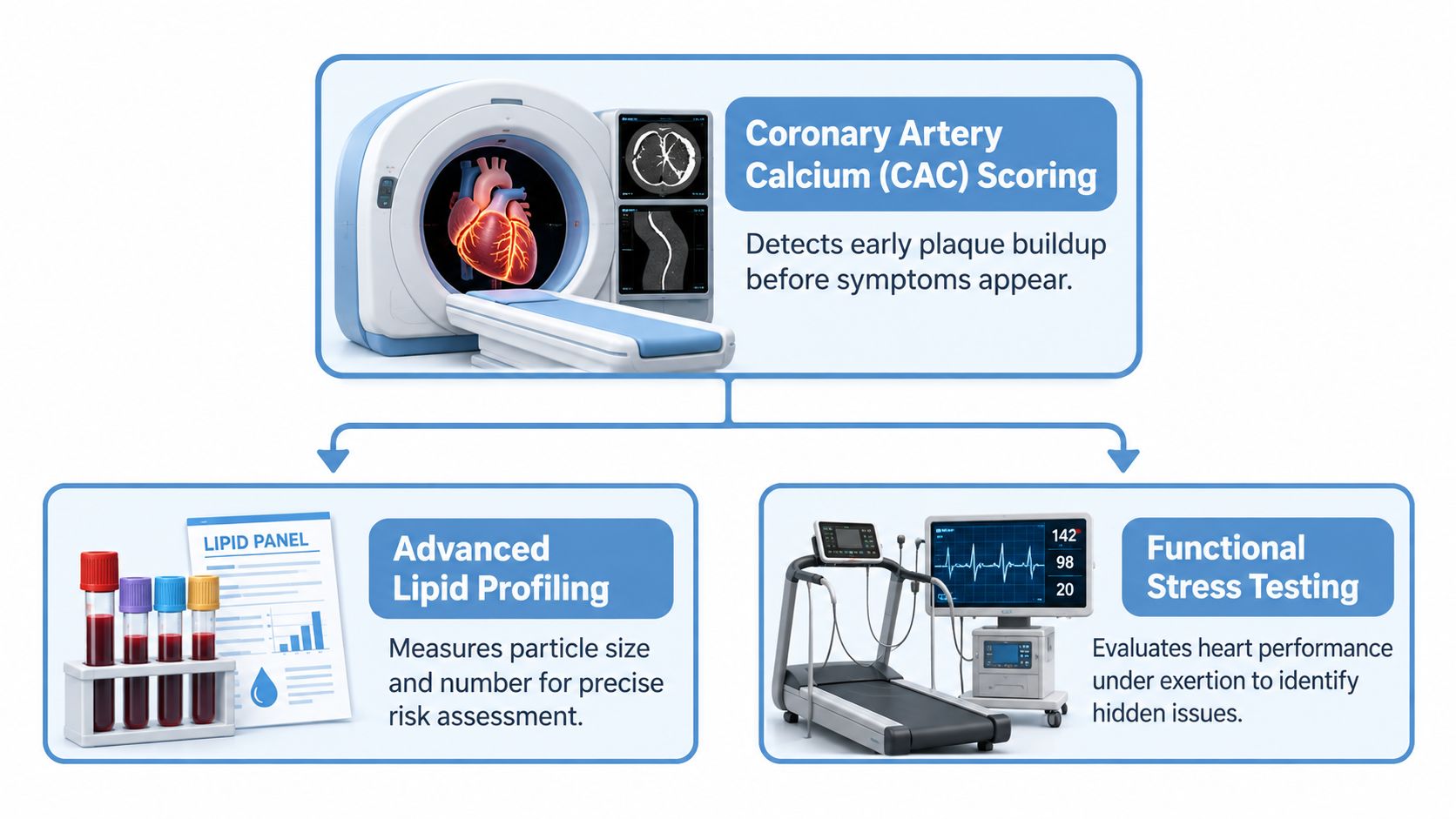
| Coronary artery calcium scoring | Uses noncontrast CT to assess calcified coronary plaque and help clarify risk when standard assessment leaves uncertainty. |
| Carotid intima-media thickness | Evaluates carotid arterial structure as one possible component of vascular assessment. |
| Stress echocardiography | Assesses cardiac structure and performance under exertion when functional information is clinically relevant. |
| Abdominal aortic ultrasound | Examines the abdominal aorta as part of selected vascular evaluations. |
| Ankle-Brachial Index with exercise | Compares blood pressure in the arms and legs, including response to activity, when peripheral arterial disease is a concern. |
| 12-lead ECG | Records the heart's electrical activity and can provide information about rhythm and conduction. |
| Ambulatory telemetry | Extends rhythm observation beyond a single office encounter when intermittent symptoms or rhythm questions warrant it. |
| Twenty-four-hour blood-pressure monitoring | Captures repeated awake and asleep readings to identify patterns that one office measurement may miss. |
| Home sleep study | Assesses selected sleep-related breathing concerns that may affect cardiovascular risk and daytime function. |
| Advanced lipid and inflammatory biomarkers | May include Lp(a), ApoB, and other markers when their results could refine risk interpretation. |
| Exercise prescription and physical therapy consultation | Converts cardiovascular findings and current capacity into a practical activity plan. |
| Registered dietitian evaluation | Aligns nutrition recommendations with laboratory findings, preferences, business meals, travel, and schedule constraints. |
| Optional integrative and coaching support | May include integrative medicine consultation, internal-medicine–led coaching, and coordinated mental-health referrals. |
Why the components need interpretation
A test result without context can create confusion. For example, a lipid marker may be high, but the appropriate response depends on the broader risk profile, family history, blood pressure, glucose status, existing disease, and treatment preferences. Similarly, an imaging result should be explained in terms of what it shows, what it doesn't show, and whether it changes prevention intensity.
A registered dietitian can make the laboratory findings operational. Instead of handing an executive a generic list of foods, the team can address restaurant meals, travel days, alcohol patterns, meeting schedules, and the practical barriers that determine whether recommendations last.
The same principle applies to exercise. A prescription should reflect current conditioning, symptoms, musculoskeletal limitations, and cardiovascular findings. The aim is not to create an impressive calendar. It's to establish a safe and sustainable routine that supports long-term risk reduction.
The strongest preventive plan is specific enough to follow and flexible enough to survive a demanding week.
Evidence-Based Advanced Cardiac Testing Explained
Advanced cardiac testing helps when it changes a real decision. In practice, that usually means clarifying risk after a routine evaluation leaves unanswered questions, not ordering every available test for every busy, symptom-free adult who wants reassurance.
Coronary artery calcium scoring
For selected adults with borderline or intermediate risk, the 2019 ACC/AHA primary-prevention guideline supports coronary artery calcium, or CAC, testing when standard assessment still leaves uncertainty. CAC quantifies calcified plaque in the coronary arteries. It does not capture every plaque type, and it does not promise what will or will not happen next.
The result matters because it can change the prevention conversation. A CAC score of 0 may reclassify risk downward in the right clinical setting. A score of 100 Agatston units or higher, or a value at or above the 75th percentile for age, sex, and race, can reclassify risk upward and strengthen the case for medication. The ACC/AHA cholesterol guidance summary also notes that a score of 0 may support deferring statin therapy in selected adults without higher-risk conditions, while scores from 1 to 99 generally favor treatment, particularly after age 55.
That is why I do not view CAC as a screening trophy for health-conscious professionals. I view it as a decision tool. If the result will not change treatment, the scan may add cost and noise without adding clarity. Learn how these modalities fit together in our guide to advanced cardiovascular imaging.
Lp(a), ApoB, and blood-pressure patterns
Standard lipids do not capture every source of risk. Lp(a) is largely inherited and can identify risk that a routine lipid panel may miss. According to the updated ACC/AHA dyslipidemia guidance, Lp(a) of at least 50 mg/dL or 125 nmol/L is a risk-enhancing factor, especially when there is a family history of premature atherosclerotic cardiovascular disease. A high Lp(a) level doesn't mean an event is inevitable. It adds context alongside LDL-C, ApoB, blood pressure, glucose, smoking exposure, and family history.
Blood pressure deserves the same level of precision. Office readings can miss sustained hypertension, overcall white-coat hypertension, or overlook masked hypertension in adults whose clinic numbers look acceptable. A peer-reviewed AHA review of ambulatory blood-pressure monitoring lists thresholds of at least 130/80 mm Hg for the 24-hour average, 135/85 mm Hg for the awake average, and 120/70 mm Hg for the asleep average. Those thresholds still need interpretation, because recording quality, sleep schedule, medications, and the patient's broader risk profile all affect how the result should guide care.
A preventive cardiology practice uses these tests selectively and in combination. The aim is straightforward: clarify whether prevention should be intensified, maintained, or adjusted differently for the person sitting in front of you.
A Coordinated Care Model for Busy Professionals
For a demanding professional, fragmented care creates a clinical problem as well as a scheduling problem. One office collects blood work, another performs imaging, a third interprets a monitor, and the patient is left to reconcile the conclusions. A physician-led model can reduce that fragmentation by placing cardiovascular-specific diagnostics and interpretation within one coordinated plan.
The practical advantage is continuity of reasoning. When Dr. Vinay Hosmane reviews imaging, laboratory markers, blood-pressure patterns, symptoms, and lifestyle factors together, the patient receives an explanation of how the pieces relate. That doesn't eliminate uncertainty, but it makes the uncertainty visible and gives the next decision a clearer foundation.

Convenience must support completion
The delivery model matters because preventive care only helps when people complete it. In a 2025 consumer survey, 65% of consumers wanted healthcare organized around prevention, and at least one in five reported willingness to pay out of pocket for personalized services. The finding supports a practical conclusion: access includes time, coordination, price transparency, and follow-up, not just geographic proximity.
For adults in Delaware, in-person care is available at the Lewes and Wilmington clinics. The practice uses a cash-pay model, and Medicare and Medicaid enrollment limitations should be clarified before scheduling. A prospective patient should ask which services are included, which are optional, how results are interpreted, and what follow-up involves.
Administrative coordination also affects the clinical experience. A patient intake coordinator can help organize records, questionnaires, scheduling details, and logistics before the visit. That administrative role doesn't replace medical judgment, but it can help the clinical appointment focus on the questions that require a physician.
One care plan instead of disconnected recommendations
The multidisciplinary team includes cardiology, cardiovascular sonography, physical therapy, registered dietitian support, operations, and optional coaching or referrals. Each discipline should contribute to the same priorities rather than issuing unrelated advice.
For an executive, that might mean connecting an ambulatory blood-pressure result to travel routines, linking lipid findings to business dining, and aligning an exercise prescription with current conditioning. The model is not about adding services for their own sake. It's about making the findings usable within the patient's actual life.
Take Control of Your Cardiovascular Health
A search for a clinic for adults near me becomes more useful when it starts with a clinical question. Does the person have a family history that changes interpretation? Are blood pressure or lipid results inconsistent? Would CAC, Lp(a), ApoB, ambulatory monitoring, or another evaluation clarify a decision? What will happen if a result is abnormal?
A sensible process begins with a consultation, a review of prior records, and a discussion of goals. The clinician can then determine which tests are appropriate, explain their limitations, and establish how results will affect prevention. Adults don't need to pursue every available assessment, and no test can promise that cardiovascular disease will be prevented.
The Hosmane Longevity Center serves adults in Lewes and Wilmington, Delaware, including professionals from Rehoboth, nearby Pennsylvania, and Maryland. Testing is available to non-members when appropriate, and the Executive Health Program combines cardiovascular evaluation with lifestyle, nutrition, and follow-up planning.
Prevention becomes actionable when a person knows what the data means, what decision it informs, and who will help carry the plan forward.
Hosmane Longevity Center offers physician-led preventive cardiology, advanced cardiac testing, and coordinated executive health evaluations for adults seeking clearer cardiovascular risk information. Visit Hosmane Longevity Center to review the Lewes and Wilmington services and schedule a consultation with Dr. Vinay Hosmane.