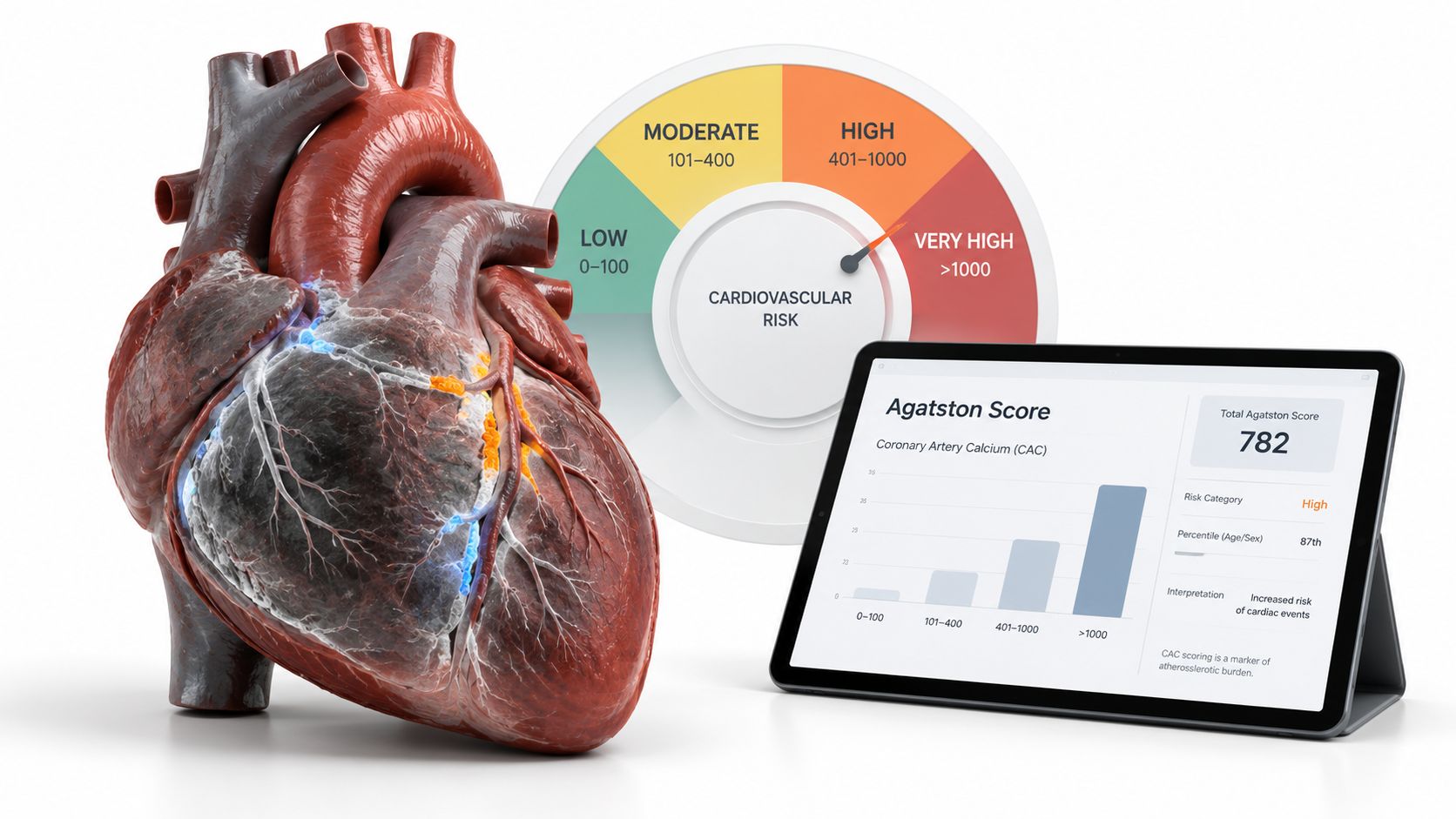
A chief executive in Wilmington receives a coronary calcium report between meetings. The result says CAC 86, but the report offers little help beyond that number. Is the score dangerous, reassuring, or something to monitor? The answer depends on more than the score itself.
Coronary calcium score interpretation works best as a clinical decision process. It combines the Agatston score, age and sex percentile, traditional risk factors, symptoms, family history, and prevention preferences. For professionals in Lewes, Rehoboth, Wilmington, and nearby Pennsylvania or Maryland, that context matters because a scan should lead to a clear plan, not another isolated data point.
The discussion below is educational, not individualized medical advice. A physician should interpret any result alongside the full clinical picture, particularly when symptoms, diabetes, significant cholesterol abnormalities, or a strong family history are present.
Table of Contents
- What Your Coronary Calcium Score Actually Measures
- How Coronary Calcium Scoring Works and Why Standardization Matters
- Understanding CAC Categories and What Each Range Means
- Integrating Your Score With Clinical Risk Models and Guidelines
- Recommended Next Steps After Your CAC Result
- Common Pitfalls to Avoid and When to Seek Expert Guidance
What Your Coronary Calcium Score Actually Measures
A CAC report measures calcified plaque in the coronary arteries. The scan uses a standardized, non-contrast CT technique to identify calcium deposited within arterial plaque. That calcium is a marker of subclinical coronary atherosclerosis, meaning atherosclerotic disease that may exist before symptoms appear. The scan doesn't measure every form of plaque, and it doesn't tell a patient whether a particular artery is currently obstructed.
Consider an executive in Rehoboth who exercises regularly, maintains a favorable blood pressure, and feels well. A score of zero would mean no detectable calcified plaque on the scan, which is generally a very favorable near-term risk signal. A score above zero would show that coronary atherosclerosis has developed, even if the person has no symptoms and performs well under pressure.
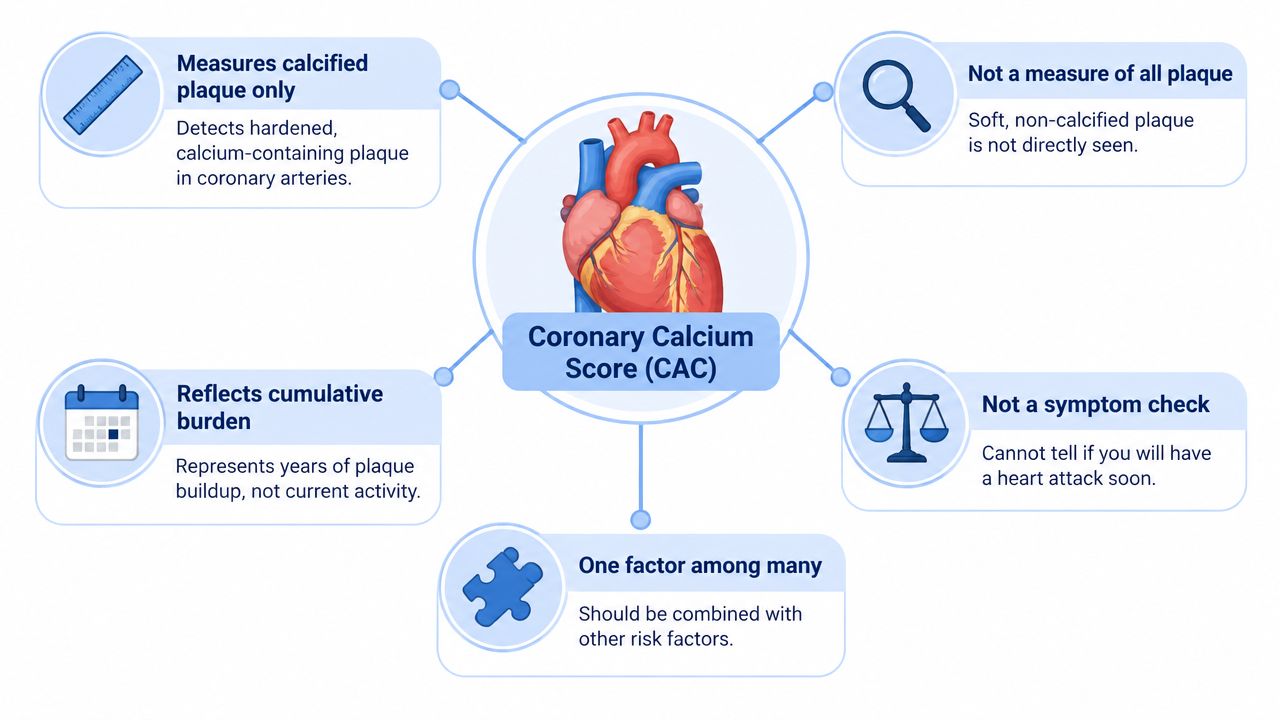
What calcium can and cannot show
CAC is a graded risk signal, not a simple yes-or-no diagnosis.
- It detects calcified plaque. Calcium reflects accumulated plaque burden in the coronary arteries.
- It can miss noncalcified plaque. Softer plaque may not appear on a CAC scan.
- It doesn't measure blockage directly. The score isn't an anatomical measurement of the artery's internal opening.
- It reflects cumulative disease burden. A result usually represents plaque accumulated over time, not a real-time measure of plaque activity.
- It doesn't evaluate symptoms. Chest pressure, shortness of breath with exertion, or declining exercise tolerance may require a different diagnostic pathway.
That last distinction prevents one of the most common misunderstandings. A person can have a zero CAC score and still require evaluation if symptoms or clinical suspicion are significant. Conversely, a higher score doesn't prove that a heart attack is imminent. It identifies a higher burden of coronary atherosclerosis that can change the intensity of prevention.
At Hosmane Longevity Center, Dr. Vinay Hosmane approaches the result as part of a broader preventive cardiology assessment. The practical question isn't, “What number appeared on the report?” It's, “What does this number mean in this patient, and what decision should it inform?”
How Coronary Calcium Scoring Works and Why Standardization Matters
The technical foundation of coronary calcium score interpretation is the Agatston score. This standardized method quantifies calcified plaque seen on CT and expresses the result as Agatston units. Because major cardiology and radiology sources use this framework, clinicians can discuss results using shared categories rather than relying on an imaging center's informal description.
A technically appropriate scan generally follows a sequence like this:
- Image acquisition: A non-contrast, ECG-gated CT captures the heart during a controlled portion of the cardiac cycle.
- Calcium identification: Software highlights dense, calcium-containing areas within the coronary arteries.
- Agatston calculation: The method accounts for the area and density of detected calcium.
- Clinical reporting: The result is recorded in Agatston units and interpreted alongside the patient's age, sex, and risk profile.
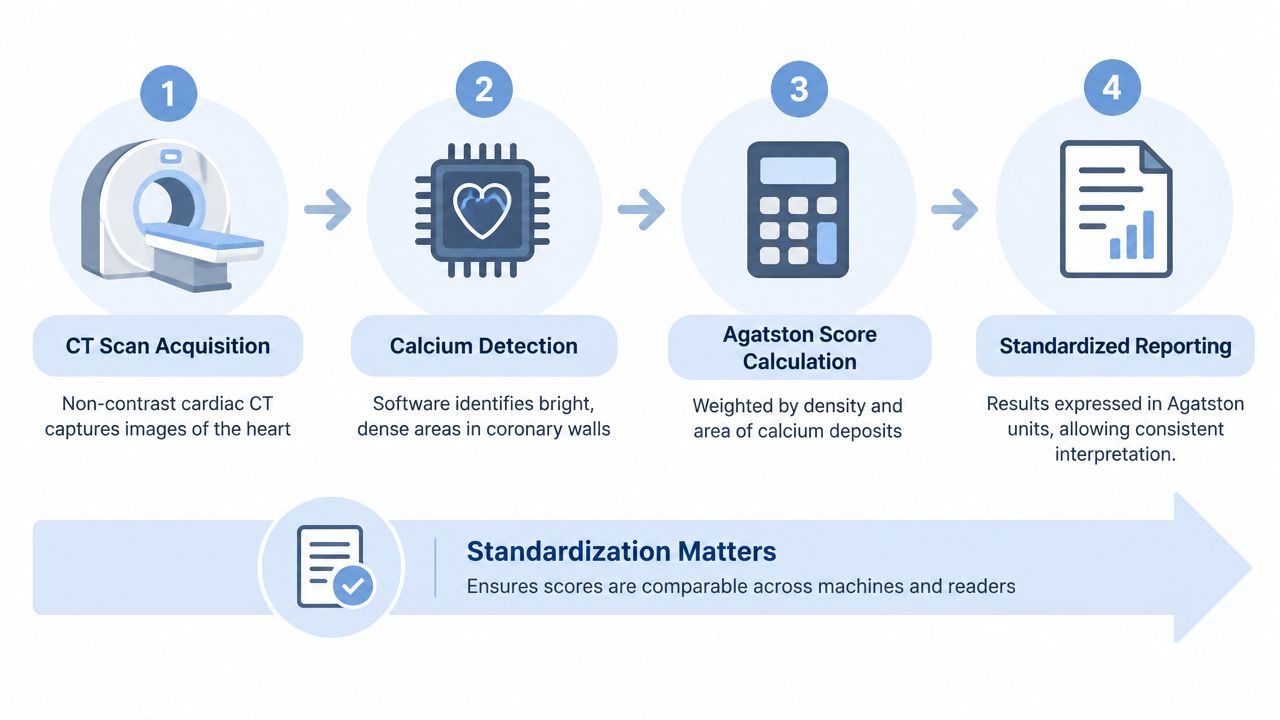
Why acquisition quality matters
A score is only as useful as the scan and reporting process behind it. The practical workflow begins by confirming that the study used a non-contrast, ECG-gated CT with Agatston scoring, as described in the Journal of the American College of Cardiology imaging guidance. The clinician can then map the result to an absolute category and an age and sex percentile.
Standardization also protects against overinterpretation. A score is not a direct measurement of arterial narrowing, and it shouldn't be treated as a diagnosis of obstructive coronary disease. It is a measure of calcified plaque burden that helps determine whether the patient's estimated risk should be revised upward or downward.
For a Delaware executive arranging testing around travel, board meetings, or family obligations, the scan itself is only one part of the process. The report should be accessible, technically clear, and connected to a physician discussion. Information about advanced cardiac testing at Hosmane Longevity Center can help patients understand how CAC fits within a larger preventive evaluation.
The key practical question is whether the scan was performed and reported in a way that supports comparison with accepted thresholds. Once that foundation is secure, the number can be placed on the clinical spectrum.
Understanding CAC Categories and What Each Range Means
A CAC result becomes useful when read as a decision range, not as an isolated number. One major review groups scores into CAC 0, CAC 1–99, CAC 100–299, and CAC 300 or higher. Another framework uses 0, 1–99, 100–399, and above 400. These cut points reflect practical ways to organize a continuous measure of calcified plaque burden, not competing diagnoses, as described in this review of CAC interpretation.
| Agatston Score | Risk Category | Clinical Meaning |
|---|---|---|
| 0 | Very low risk signal | No detectable calcified plaque. This often supports a favorable near-term risk assessment, but it does not exclude noncalcified plaque or obstructive disease when symptoms or other findings raise concern. |
| 1–99 | Mildly increased risk | Definite subclinical atherosclerosis is present. The burden is relatively low, but the result is not considered normal. |
| 100–299 | Moderately increased risk | A more substantial plaque burden is present. Preventive treatment intensity commonly increases, particularly when traditional risk is also elevated. |
| 300 or higher, with some frameworks using 400 or higher | High or moderate-to-severely increased risk | The calcified plaque burden places the patient in a substantially higher-risk tier, where intensive risk-factor management is usually favored. |
A score of zero
CAC 0 is reassuring because the scan found no detectable calcified plaque. For an adult whose clinical risk is borderline or uncertain, that finding can support deferring statin therapy in many situations. The decision still depends on age, smoking, diabetes, family history, symptoms, and why the scan was obtained.
A zero score means very low near-term risk, not permanent protection from coronary disease. CAC does not show noncalcified plaque. Its meaning also changes with context: zero in an asymptomatic younger executive may carry a different interpretation from zero in a symptomatic patient.
CAC 1–99
A score in this range confirms that coronary atherosclerosis is present. The National Lipid Association statement notes that 10-year event rates in this category often remain intermediate. That helps explain why CAC 1–99 is not treated as a normal result.
Age and sex percentile can change the practical meaning. For an executive in the mid-40s, a score in this range may be more unusual, and therefore more concerning, than the same absolute score later in life. The Agatston category answers how much calcified plaque is present. The percentile asks how that burden compares with people of the same age and sex.
CAC 100 and above
CAC 100 indicates a more meaningful plaque burden. A guideline-focused review describes CAC 100 or higher, or a result above the 75th percentile, as strongly supporting statin initiation in appropriate adults. In a previously uncertain discussion, that finding can provide a clearer reason to begin medication alongside diet, exercise, blood-pressure management, and other preventive measures.
Percentile context adds a second lens. A modest absolute score may be unusually high for a younger patient, while an older adult may have the same score at a less unusual percentile. Sound interpretation uses both views, then connects them with the person's broader risk profile and practical next steps.
Integrating Your Score With Clinical Risk Models and Guidelines
A CAC score is most useful when it resolves a clinical question. It does not replace an overall risk assessment. Instead, it refines the estimate built from blood pressure, cholesterol, smoking status, diabetes, age, sex, family history, and other relevant factors. For a Delaware executive deciding whether prevention should become more intensive, the score is one part of a stepwise decision, not a stand-alone verdict.
Guideline-based interpretation generally follows three pathways for adults whose treatment decision remains uncertain:
- CAC 0: In many borderline-risk adults, postponing statin therapy can be reasonable after a clinician reviews the full context.
- CAC 1–99: Statin therapy is favored according to age and the rest of the risk profile.
- CAC 100 or higher, or above the 75th percentile: Statin initiation is strongly supported in appropriate adults.
These categories help convert an imaging result into an action. A zero score may support continued lifestyle-focused prevention for some people. A positive score can shift the discussion toward medication, lipid targets, blood-pressure control, exercise, nutrition, and follow-up. The right decision still depends on symptoms, medical history, treatment preferences, and the reason the scan was ordered.
The broader evidence review associates CAC 100 or higher with observed 10-year ASCVD incidence rates of at least 7.5 events per 1,000 person-years. That level of observed risk can support pharmacologic prevention for many patients, particularly when traditional risk is also high.
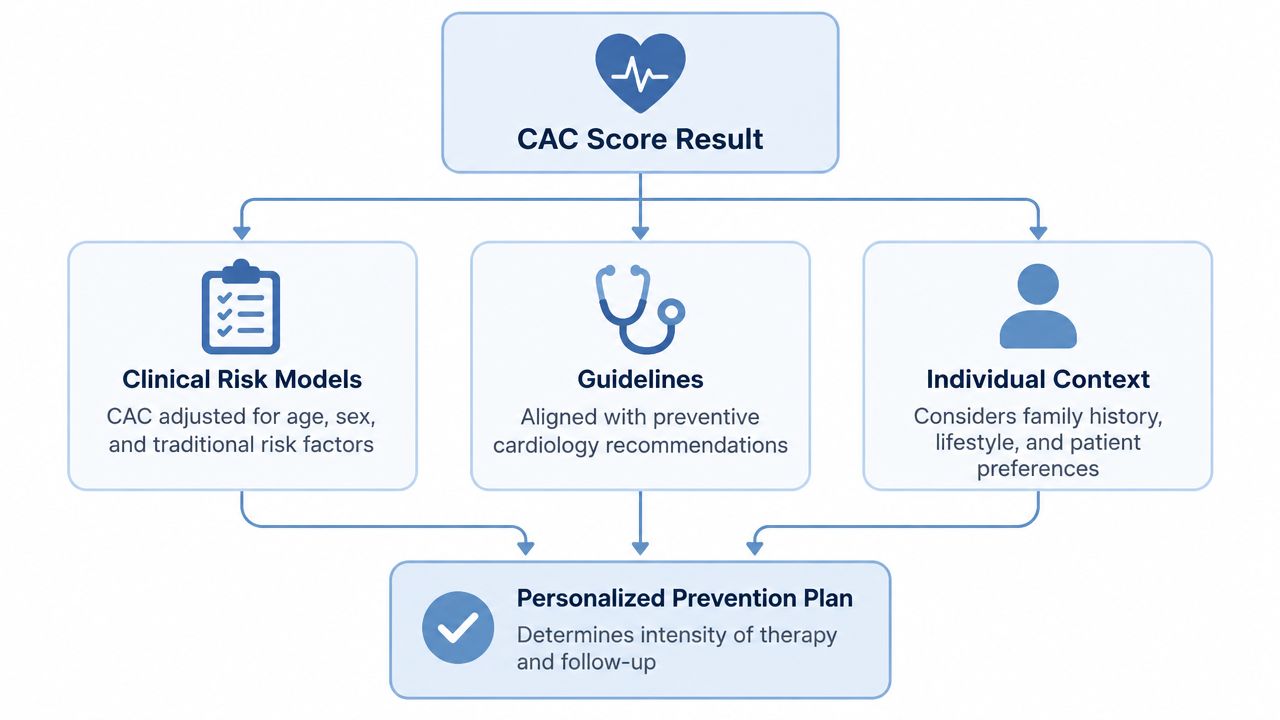
Why age and sex percentiles change the conversation
The Agatston score measures the amount of detected calcified plaque. The percentile compares that burden with people of the same age and sex. Both views matter because a modest absolute score can be unusually high in a younger adult, while the same score may be less unusual later in life.
A result above the 75th percentile is a guideline-relevant risk enhancer. This matters most when a traditional calculator places someone near a treatment threshold. Percentile context can also identify unexpectedly early atherosclerosis, prompting a closer review of family history, cholesterol exposure, blood pressure, and lifestyle.
Where advanced biomarkers fit
Lipid values describe circulating risk factors. CAC shows whether calcified atherosclerotic plaque has developed. Neither measurement provides the whole picture. Clinicians may consider Lp(a) and ApoB when family history, premature cardiovascular disease, or a mismatch between standard cholesterol results and imaging leaves an important question unresolved.
A focused ApoB evaluation can be part of that discussion. The goal is to clarify residual risk and select an appropriate prevention plan. CAC reclassifies risk. Clinical judgment determines what that reclassification means for the individual.
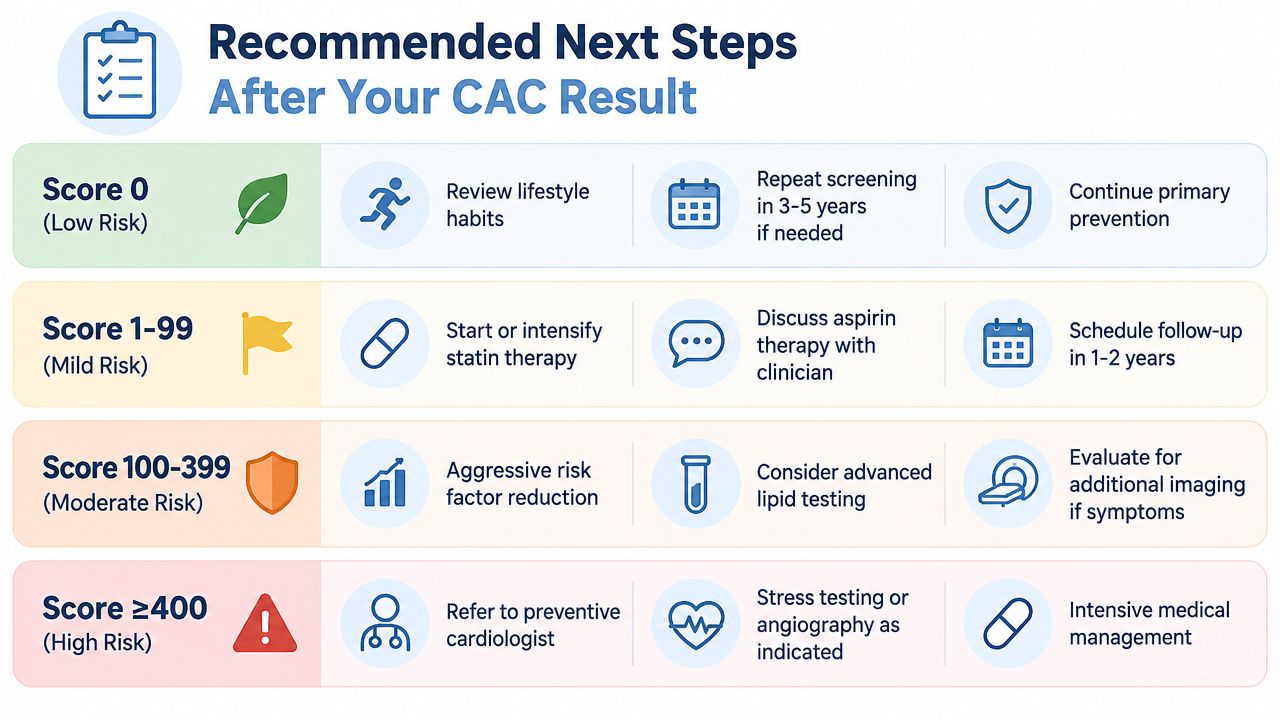
Recommended Next Steps After Your CAC Result
The next action should match the score and the question that prompted testing. A zero result may support continued primary prevention, while a higher result may justify more intensive attention to lipids, blood pressure, glucose regulation, exercise, nutrition, and symptoms. None of those steps should be selected from the score alone.
If the score is zero
A clinician may review lifestyle habits, blood pressure, lipids, glucose status, smoking exposure, sleep, and family history. For low-risk patients with CAC 0, a recent NLA summary reports repeat scanning generally in 5–7 years. For borderline or intermediate-risk patients, the interval is generally 3–5 years, while high-risk patients or those with diabetes may be considered for repeat imaging in about 3 years (NLA timing summary).
The interval isn't a countdown that applies to everyone. A major change in risk factors or new symptoms can alter the appropriate evaluation.
If the score is 1–99
The result confirms subclinical atherosclerosis, so the conversation usually shifts toward stronger risk-factor control. Depending on the overall profile, a clinician may discuss statin therapy, lipid targets, blood pressure, exercise structure, nutrition, and whether advanced biomarkers would clarify residual risk.
A low positive score shouldn't create panic, but it shouldn't be filed away as normal. The value lies in using the early signal to make prevention more deliberate.
If the score is 100 or higher
Scores in the moderate or high tiers generally prompt a more intensive prevention review. That may include lipid-lowering treatment, closer attention to blood pressure and metabolic risk, and evaluation of symptoms before deciding whether functional or anatomical testing is appropriate.
Patients should also bring the complete report, not only the total score. Per-vessel findings, technical comments, and incidental observations may affect the physician's interpretation.
Building prevention around an executive schedule
A plan has to survive real life. At the Hosmane Longevity Center executive health program, preventive care can include physician-led risk review, exercise prescription, registered dietitian support, and monitoring selected to fit travel, business meals, and demanding schedules. Testing is available to individuals who aren't program members as well.
The purpose isn't to create a larger testing list. It's to connect relevant data with practical decisions, such as a sustainable exercise routine, a nutrition strategy compatible with frequent travel, and a follow-up schedule that keeps risk management visible.
Common Pitfalls to Avoid and When to Seek Expert Guidance
A CAC score of zero is reassuring, but it is not a rule-out test. CAC may miss noncalcified plaque or thrombotic occlusions, and a zero score does not reliably exclude obstructive coronary disease, particularly in younger or symptomatic patients. If clinical suspicion remains high, a physician may consider coronary CT angiography or functional testing rather than relying on CAC alone (clinical limitations review).
Symptoms require a separate evaluation. New exertional chest pressure, unexplained shortness of breath, fainting, or a marked decline in exercise tolerance warrants timely medical attention. A screening score cannot explain symptoms, so a reassuring result should not delay care.
Why repeated scanning can mislead
Serial CAC is a poor short-term way to monitor treatment. Plaque-stabilizing therapy can increase calcium density even as cardiovascular risk falls. A rising score, therefore, does not necessarily mean prevention has failed, and routine repeat scanning is generally not recommended for measuring short-term response.
Radiation exposure and incidental findings also merit a balanced discussion. Incidental findings may appear in up to 40% of scans, while radiation exposure is about 0.89–1 mSv and may be higher in patients with BMI above 30 kg/m² (limitations and screening considerations). These considerations support selecting patients carefully and having a physician interpret the full report.
Practical rule: A CAC result should answer a management question. If the scan will not change the plan, or symptoms call for another test, more imaging may add information without adding clarity.
At Hosmane Longevity Center, Dr. Vinay Hosmane reviews cardiovascular findings in person at the Lewes and Wilmington clinics. Imaging is considered alongside risk modeling, laboratory data, symptoms, and patient priorities, helping busy professionals turn a report into a prioritized prevention plan.
Hosmane Longevity Center offers physician-led preventive cardiology, advanced cardiac testing, and executive health evaluations. Visit Hosmane Longevity Center to discuss a CAC result with Dr. Vinay Hosmane and develop an evidence-based prevention plan suited to the patient's health profile and schedule.