
What if the core issue with many executive health programs isn't too little testing, but too little judgment about which tests change care?
For busy professionals in Lewes, Wilmington, Rehoboth, and nearby Pennsylvania and Maryland, the appeal of an executive health program is obvious. The harder question is whether the program is built to find meaningful cardiovascular risk, explain it clearly, and keep working after the appointment ends. That distinction matters because a one-day screening can create a lot of information without necessarily creating a better plan.
The best executive health programs are not defined by how many items appear on a menu. They're defined by physician-led interpretation, guideline-aligned testing, and follow-through that fits real schedules. In preventive cardiology, that usually means choosing tests for the right person, at the right time, and then translating results into a practical plan for blood pressure, lipids, sleep, stress, and behavior change.
| Evaluation Criteria | What to Look For | Why It Matters for Risk Reduction |
|---|---|---|
| Physician leadership | Direct interpretation by a cardiologist or prevention-focused physician | Reduces fragmented findings and helps prioritize what matters |
| Cardiovascular focus | Testing built around plaque, blood pressure, rhythm, and vascular risk | Finds subclinical disease earlier than a basic physical |
| Biomarker depth | Advanced lipids, inflammatory markers, and risk modifiers | Helps uncover hidden risk that standard panels can miss |
| Follow-through | Clear next steps, follow-up, and care coordination | Screening only helps if findings lead to action |
| Schedule fit | Efficient visits, in-house testing, and minimal friction | Busy adults are more likely to complete and use the program |
Table of Contents
- Introduction Why Choosing the Right Executive Health Program Matters
- What Defines a High Quality Executive Health Program
- How Top Executive Health Programs Compare on What Matters Most
- Advanced Cardiac Testing and Biomarkers That Reveal Hidden Risk
- Which Program Model Fits Different Executive Needs and Schedules
- How to Choose and Implement the Right Program Without Wasting Time
- Next Steps Toward Proactive Heart and Longevity Care in Delaware
Introduction Why Choosing the Right Executive Health Program Matters
Does a longer test list really mean better care? In preventive cardiology, the answer is usually no. What matters is whether testing is selected well enough to clarify future risk and guide the next step.
The executive-health market has long reflected that tension. A 2002 study of a periodic executive health examination program found that about 65% of eligible executives participated annually executive health study summary. In the same 3-year analysis, participants had lower medical claims costs, $5,361 vs. $6,426, and fewer short-term disability days, 0.93 vs. 1.34 days per year executive health study summary. Those findings helped establish executive health as more than a physical exam, since the value came from screening plus better action afterward.
The category has since expanded, and demand is clearly there. One independent market report estimates the executive health programs market at USD 7.8 billion in 2025, with a projected rise to USD 14.6 billion by 2032, implying a 9.4% compound annual growth rate executive health market projection.pdf). Growth suggests more access to preventive care, but it does not guarantee that testing choices are clinically sound.
For an executive or professional in Delaware who wants proactive heart and longevity care, the right question is risk reduction. The best program identifies hidden cardiovascular risk, interprets advanced testing in context, and supports follow-through after the visit.
For example, Hosmane Longevity Center is a practice built on this preventive cardiology model, led by Dr. Vinay Hosmane, with testing available to people who want a cardiology-focused evaluation, not only formal program members. That distinction matters because value comes from a plan that fits a busy schedule and still keeps the prevention strategy coherent.
What Defines a High Quality Executive Health Program
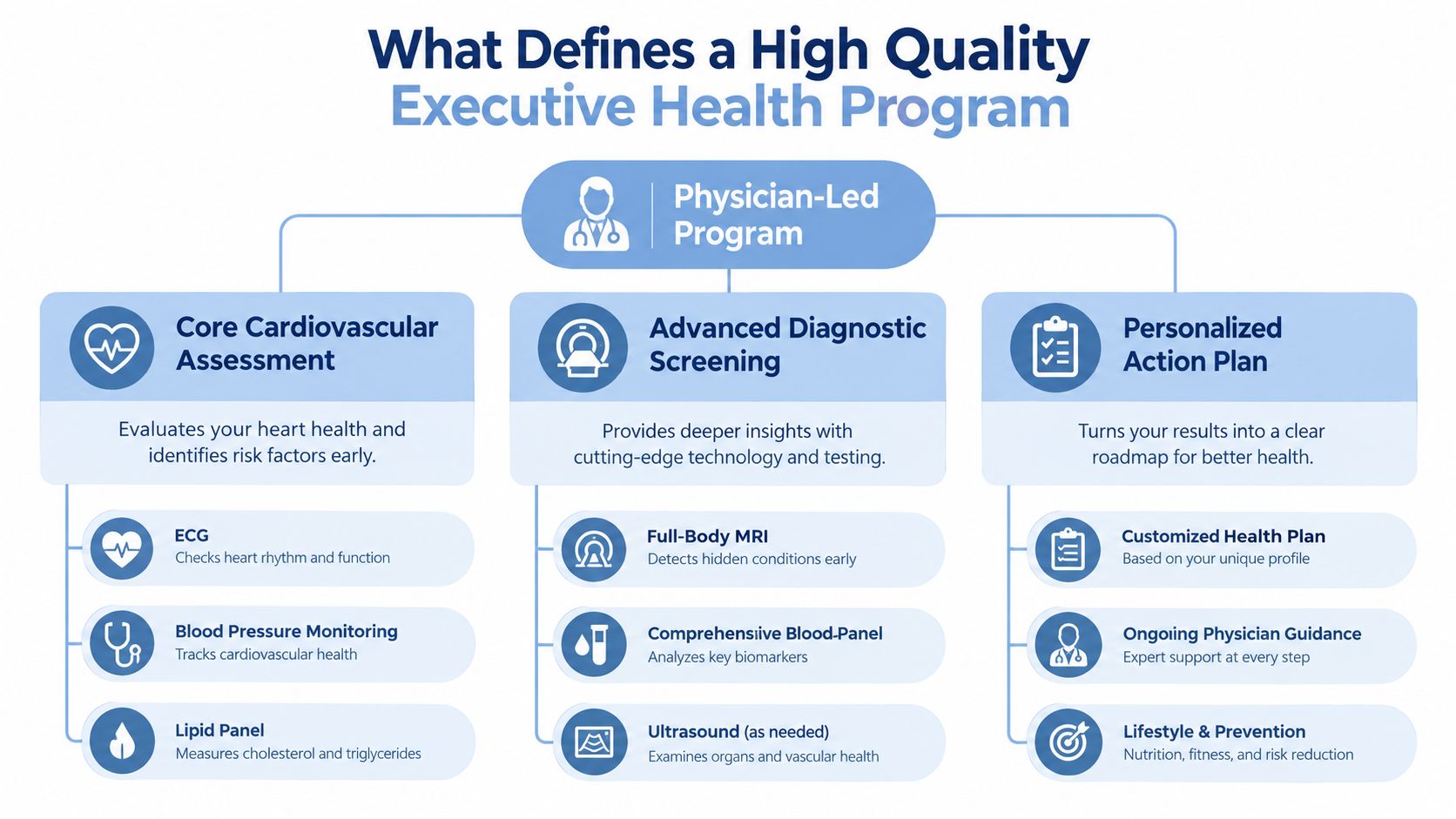
A high-quality executive health program starts with a simple idea, testing should serve a clinical purpose. It should not be a pile of impressive items. It should be a connected system that helps a physician decide what a person's risk really looks like, especially when symptoms haven't shown up yet.
The core pieces should work together
A strong program usually begins with a core cardiovascular assessment, then adds advanced diagnostics only when they answer a real question. That means blood pressure review, ECG, vascular assessment, sleep evaluation when appropriate, and advanced lipids such as Lp(a) and ApoB when hidden risk is on the table. The point is to connect those findings to a single interpretation, not leave the patient with a binder full of disconnected reports.
That's where physician leadership matters. A prevention-focused doctor can decide whether a test is useful for the person in front of them, or whether it's just expensive noise. The AHA, ACC, and ESC all emphasize risk-based prevention and assessment rather than blanket over-testing, which is why a good executive health program should feel selective, not random.
Practical rule: If a test result doesn't change the plan, it probably shouldn't be routine.
Longitudinal care matters as much as the visit
The second pillar is follow-through. A single-day assessment can be helpful, but it leaves the hardest work untouched if nobody revisits the findings, updates the plan, or helps with implementation. Busy executives don't need more paperwork, they need a physician who can explain what was found, what was not found, and what should happen next.
That includes lifestyle support that fits reality. Exercise advice has to account for travel, meal timing, and time pressure. Nutrition planning has to work in business settings, not idealized ones. When needed, sleep support, mental-health referral, and coaching should be part of the same care pathway rather than separate add-ons.
More detail on the physician side is available on the Hosmane Longevity Center team page, which helps clarify why leadership, interpretation, and prevention skills belong at the center of this kind of care.
How Top Executive Health Programs Compare on What Matters Most
A useful comparison starts with the right criteria. The difference between one program and another often isn't “better versus worse,” it's whether the program is built for screening, risk modeling, or longitudinal prevention. Those are not the same thing.
| Evaluation Criteria | What to Look For | Why It Matters for Risk Reduction |
|---|---|---|
| Physician interpretation | Direct review by a prevention-trained physician | Helps convert raw data into a coherent plan |
| Cardiovascular diagnostics | CAC, vascular testing, ECG, blood pressure monitoring, and sleep evaluation when relevant | Finds plaque, rhythm issues, and hemodynamic risk earlier |
| Biomarker selection | Lp(a), ApoB, and other context-specific labs | Identifies hidden risk that standard cholesterol alone can miss |
| Care coordination | One plan across diagnostics, nutrition, exercise, and follow-up | Prevents findings from getting lost between visits |
| Schedule fit | Efficient visits and in-house workflow | Increases completion for time-pressed adults |
| Longitudinal support | Follow-up, course correction, and coaching | Turns one assessment into a usable prevention strategy |
A program with a broad menu but weak interpretation can leave an executive with more anxiety, not more clarity. A program with narrower testing but strong clinical judgment can be more useful because it asks the right question first, then tests for the answer.
Key distinction: Breadth of testing is not the same as depth of care.
The comparison becomes even more important when the patient already has a risk signal, but not a diagnosis. Family history, high Lp(a), high ApoB, sleep disruption, and stress all push the conversation toward whether the program can sort through overlapping risks and prioritize them. Without that prioritization, the appointment can turn into a set of isolated observations.
Another difference is whether the program respects the executive's schedule. The best model is efficient without feeling rushed. It uses in-house diagnostics where possible, avoids unnecessary handoffs, and gives a written plan that makes the next 90 days clearer instead of more confusing.
Advanced Cardiac Testing and Biomarkers That Reveal Hidden Risk
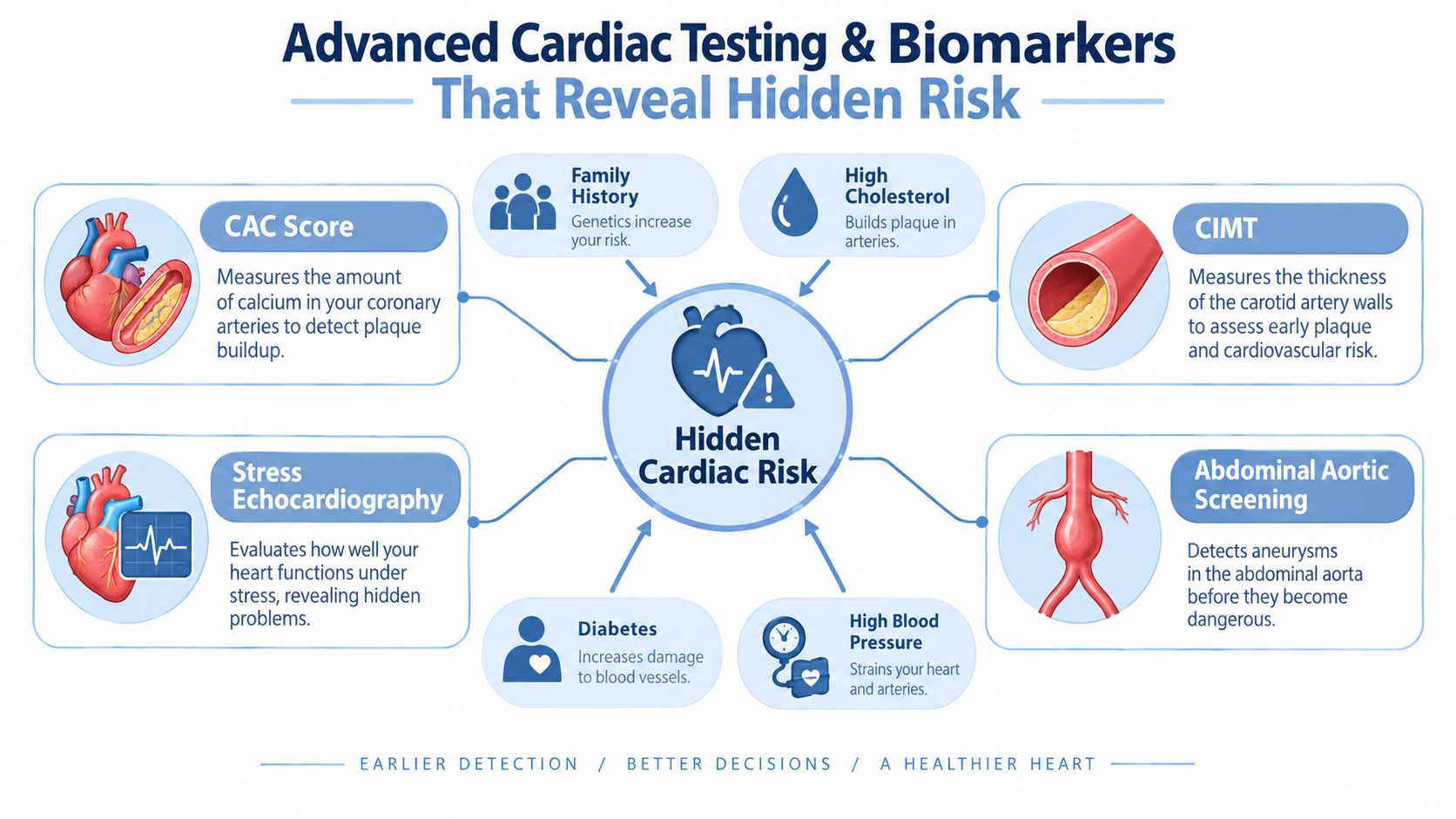
The most useful advanced testing is the kind that answers a precise question. For an asymptomatic executive with strong family history or unfavorable lipids, that question is often whether there's subclinical atherosclerosis or another hidden risk pattern that a routine physical might miss.
Tests that fit a risk-based strategy
CAC, or coronary artery calcium scoring, helps estimate plaque burden. CIMT looks at carotid artery wall thickness. Stress echocardiography evaluates how the heart performs under load, and abdominal aortic ultrasound can detect aneurysm risk in the right context. Used well, these tests are part of a risk conversation, not a shopping list.
Other tools matter too. A 12-lead ECG can identify rhythm or conduction issues. Ambulatory telemetry and 24-hour blood pressure monitoring help capture patterns that single office readings may miss. A home sleep study can be valuable when sleep apnea is a concern, because sleep and blood pressure often travel together in real life.
Advanced labs deserve the same discipline. Lp(a) and ApoB are especially important in hidden-risk discussions because they can clarify risk that standard panels understate. For a prevention-minded physician, these biomarkers are useful because they help decide how aggressive the next step should be. More on ApoB interpretation is available in the ApoB test guide.
Testing is for the person, not the brochure
These tools should be selected, not automatically bundled. A person with high blood pressure and poor sleep may need a different sequence than someone with strong exercise habits but a concerning lipid profile. That's why evidence-based selection matters more than volume, and why guideline thinking from the AHA, ACC, and ESC remains relevant.
The right question is not, “What else can be tested?” It's, “What result would actually change care?”
Testing is available to anyone, not only program members, which matters for adults who want a focused preventive cardiology evaluation without committing to a broad membership model. That flexibility can be especially useful when the goal is clarity about hidden risk, not a large package of services.
Which Program Model Fits Different Executive Needs and Schedules
An asymptomatic executive with family history usually needs a different structure than a frequent traveler with a packed calendar. That sounds obvious, but many programs still use the same template for people with very different risks and constraints. The better model is the one that fits the person's real-world life.
The family-history profile
A professional in their 40s or 50s who feels fine but has a parent with premature heart disease often benefits from a program that focuses on hidden risk rather than broad wellness branding. In that setting, high Lp(a) or ApoB can become the starting point for a more precise cardiovascular conversation. The goal is not to create alarm, but to avoid missing an inherited pattern that won't show up in a quick annual exam.
That profile often needs direct interpretation from a cardiologist and a clear written plan. If lifestyle changes are recommended, they should be translated into specific steps the person can realistically maintain. General advice rarely holds up when the calendar is full and meals happen between meetings.
The travel-heavy executive
A person who flies often or works across multiple cities needs something else, efficient logistics. On-site diagnostics, consolidated visits, and quick coordination matter because fragmented scheduling is where prevention falls apart. When the calendar is crowded, even a good plan can fail if it requires too many separate appointments.
That is where integrated support becomes relevant. Exercise prescription, physical therapy consultation, dietitian-led nutrition planning, and mental-health referral should be connected to the same clinical review. If stress, sleep, and business meals are part of the problem, the plan has to acknowledge them instead of pretending they don't matter.
The patient with scattered prior results
Some adults arrive with years of labs, scans, and half-finished recommendations. They don't need more fragments. They need synthesis. A physician-led program that pulls prior records into one interpretation can reduce duplication and help the patient understand what has changed, what hasn't, and what deserves attention now.
Hosmane Longevity Center's program overview is one example of this kind of structure, with advanced diagnostics, risk modeling, and coordinated prevention under one physician-led framework.

How to Choose and Implement the Right Program Without Wasting Time
The fastest way to waste time is to compare programs only by surface features. A better approach is to ask whether the program can support prevention across the full arc of care, from the first visit to the follow-up plan.
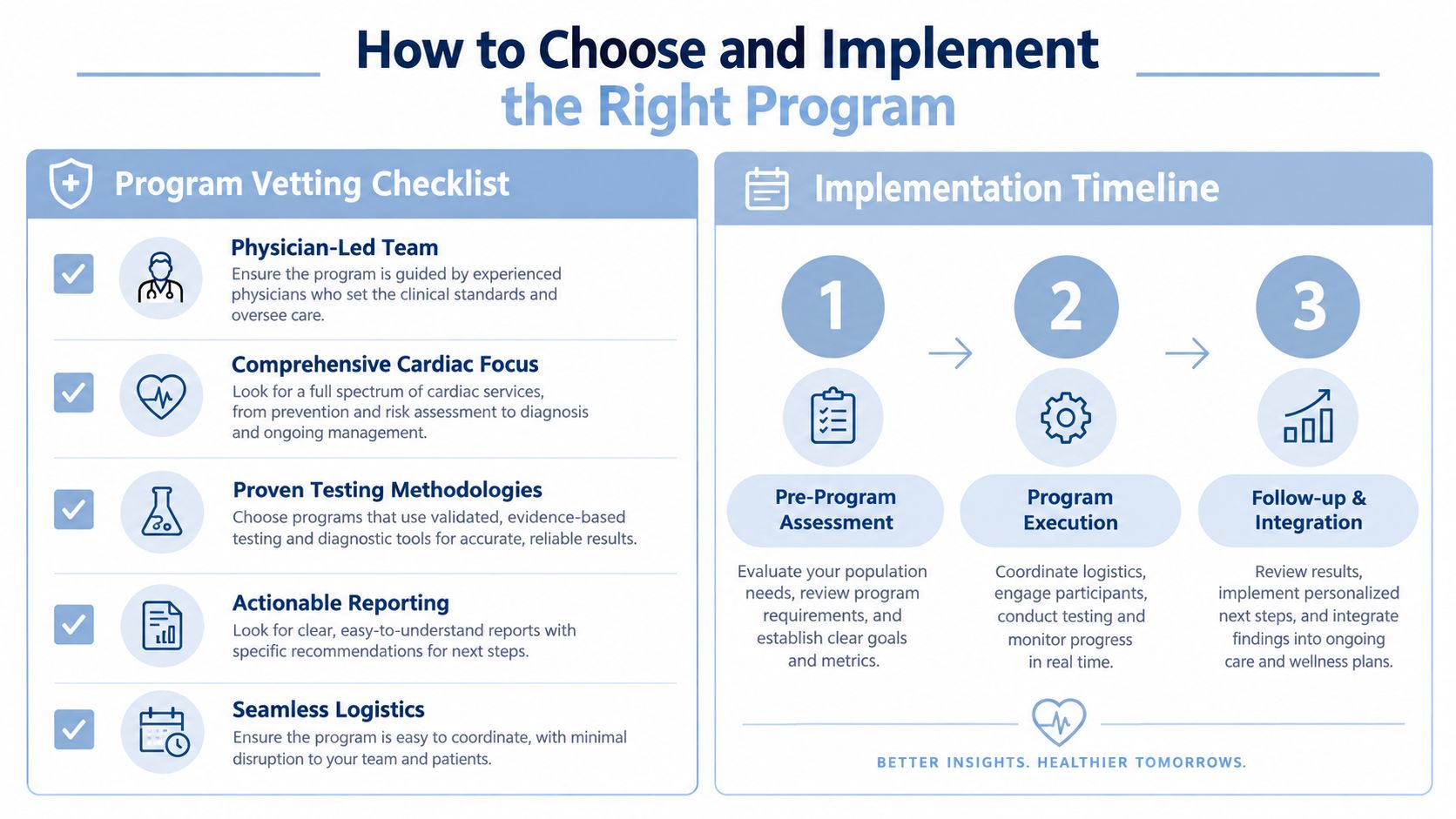
A simple vetting checklist
- Physician-led interpretation: Ask who explains the results and whether that person has cardiology or preventive expertise.
- Cardiovascular-specific diagnostics: Confirm that the program can evaluate plaque, blood pressure, rhythm, and vascular risk when indicated.
- Evidence-based test selection: Ask how the team decides which tests are appropriate and which are not.
- Actionable reporting: Look for a written plan, not just a summary of numbers.
- Logistical coordination: Make sure the schedule, testing, and follow-up are organized around your calendar, not the other way around.
A few questions cut through marketing quickly. What happens after the visit? Who coordinates nutrition, exercise, and any needed referrals? How are prior records reviewed? A good program will answer those clearly and without evasiveness.
What implementation should feel like
For adults in Lewes or Wilmington, an in-person program should feel organized from the start. Records and prior labs should be gathered before the appointment when possible, so the physician can focus on interpretation rather than sorting through paperwork during the visit. Cash-pay models should be transparent about what is included and what follows later, especially when a person is comparing single-visit evaluation with longer-term care.
Useful filter: If the plan cannot be explained in plain language, it probably isn't ready for implementation.
The final test is whether the program helps the patient act. If the report ends with confusion, the value drops. If it ends with a prioritized list, a realistic schedule, and a clear follow-up structure, then the visit has real preventive weight.
Next Steps Toward Proactive Heart and Longevity Care in Delaware
The right executive health program is the one that helps a busy adult make better cardiovascular decisions, not just collect more data. For someone in Delaware or nearby PA and MD who wants early detection of subclinical atherosclerosis, clearer risk modeling, and physician-led follow-up, a preventive cardiology program can be a practical next step.
At Hosmane Longevity Center, Dr. Vinay Hosmane leads a physician-guided approach centered on advanced cardiovascular diagnostics, risk interpretation, and personalized prevention planning. That kind of structure is especially relevant when hidden risk factors like Lp(a), ApoB, sleep disruption, or blood pressure patterns need a more careful look than a standard annual exam can provide.
The broader point is simple. A high-quality executive health program should help turn uncertainty into a plan that fits a demanding life. It should be grounded in evidence, selective in testing, and strong on follow-through.
If proactive heart and longevity care sounds right for your situation, schedule a visit with Hosmane Longevity Center to discuss a physician-led executive health program, advanced cardiac testing, and a personalized prevention plan. Dr. Vinay Hosmane and the team work with adults in Lewes, Wilmington, Rehoboth, and nearby Pennsylvania and Maryland who want clear next steps, not vague reassurance.