
A Delaware executive can have reassuring routine cholesterol results, a demanding travel schedule, and no symptoms, yet still wonder whether family history is hiding a cardiovascular risk that standard testing hasn't captured. That question often becomes more urgent after a parent or sibling develops heart disease earlier than expected, or when a professional learns that LDL cholesterol doesn't describe every artery-related particle in the bloodstream.
The Lp(a) blood test, pronounced “L-P-little-a,” addresses that blind spot. Lp(a) is a largely inherited lipoprotein that can raise cardiovascular risk even when familiar lipid results appear acceptable. It isn't another number to chase month to month. It's a risk signal that can change how carefully a clinician evaluates hidden atherosclerosis, controls modifiable risk factors, and considers testing for close relatives.
The discussion below is educational, not individualized medical advice. Dr. Vinay Hosmane and the team at Hosmane Longevity Center use physician interpretation to place advanced cardiac testing in a broader clinical context. Testing is available to anyone, not only Executive Health Program members, and a consultation can help professionals in Lewes, Wilmington, Rehoboth, and nearby Pennsylvania and Maryland understand what a result means before making decisions.
Table of Contents
- Introduction for Busy Professionals Considering Lp(a) Testing
- What Lipoprotein(a) Is and Why It Behaves Differently
- Understanding Lp(a) Units Thresholds and Risk Categories
- Why Higher Lp(a) Matters for Heart and Vascular Health
- How Lp(a) Results Shape Preventive Cardiology Decisions
- Testing Considerations Preparation and When to Retest
- Next Steps Toward Personalized Heart Risk Clarity
Introduction for Busy Professionals Considering Lp(a) Testing
A 52-year-old business owner might arrive for an annual review with acceptable LDL cholesterol, normal blood pressure in the office, and a strong exercise routine. The concern may come from elsewhere: a father with an early heart attack, a sibling with unexpectedly high cholesterol, or a sense that standard labs haven't explained the family's cardiovascular history.
That situation is common enough to deserve a more precise conversation. Lp(a) can reveal inherited risk that routine cholesterol testing may not show, and its value lies less in predicting a specific event than in helping a clinician decide how seriously to investigate and manage the total risk profile.
The question behind the test
Many professionals ask whether an Lp(a) result will tell them what to eat next month or whether a supplement is working. Usually, that's the wrong frame. Lp(a) is primarily used for risk stratification, while diet, exercise, blood pressure, glucose, LDL-related particles, sleep, and smoking status remain central modifiable influences on cardiovascular health.
A thoughtful evaluation asks several questions:
- What does the result measure? The report may use particle concentration or mass, and those units aren't interchangeable.
- Is the value clearly high or near a decision threshold? The answer affects how much weight the result deserves.
- Does family history support cascade testing? A high result may be relevant to first-degree relatives.
- Should prevention become more intensive? The decision depends on the entire clinical picture, not Lp(a) alone.
Practical rule: A high Lp(a) result isn't a diagnosis of blocked arteries. It's a reason to make the search for hidden risk and the control of preventable risk factors more deliberate.
The sections that follow explain the biology, units, thresholds, cardiovascular meaning, testing logistics, and situations in which repeating the test may make sense. The goal is clarity, not alarm. For a busy professional, the most useful result is a number translated into a prioritized plan that fits real work, travel, family, and time constraints.
What Lipoprotein(a) Is and Why It Behaves Differently
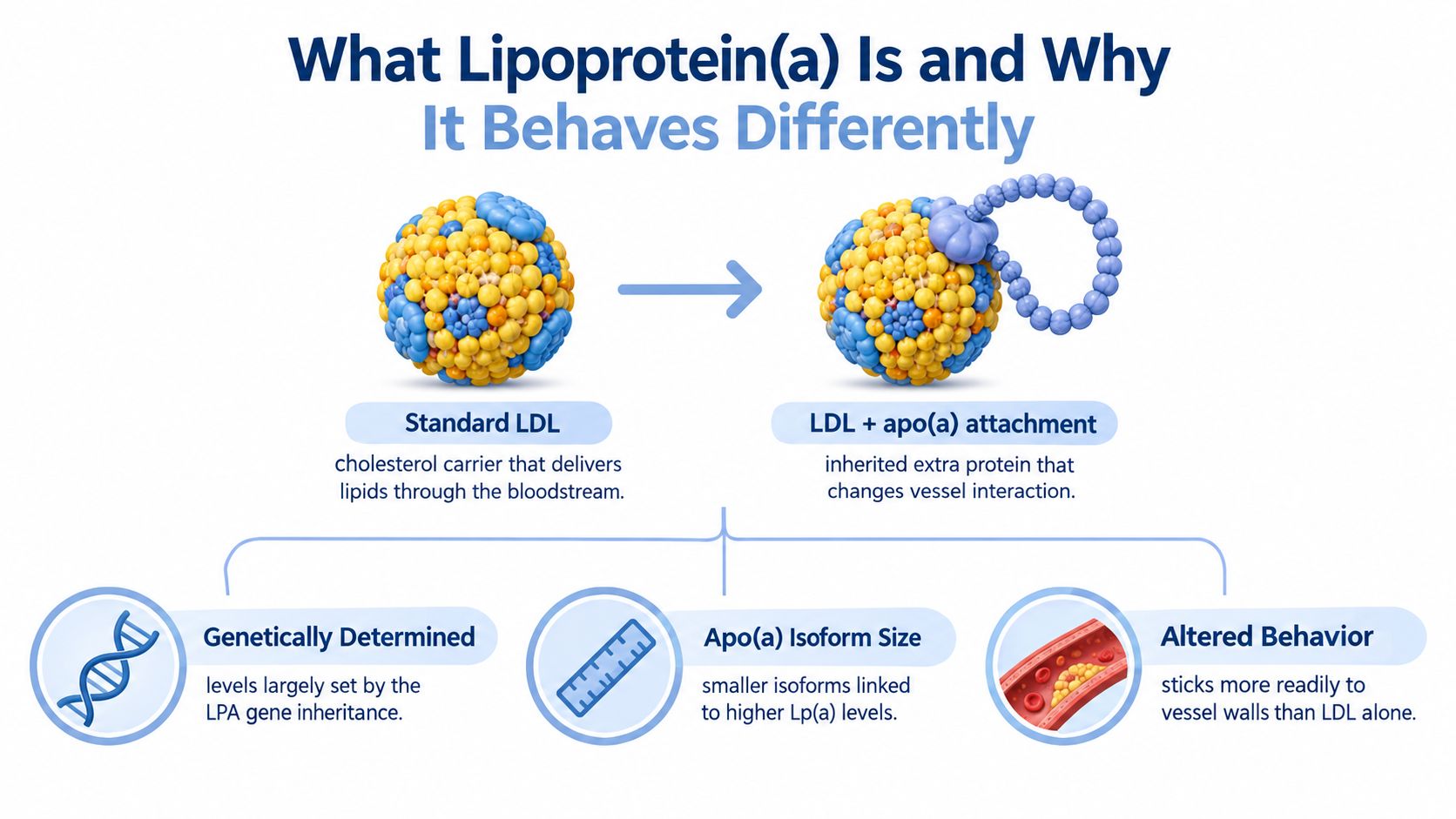
First learning about cholesterol often involves LDL, frequently described as a carrier that moves cholesterol through the bloodstream. Lp(a) resembles LDL but has an additional protein component called apolipoprotein(a), or apo(a), attached to it. A useful analogy is a standard delivery vehicle with an inherited attachment that changes where it travels and how it interacts with vessel walls.
Why genetics matter
The body produces apo(a) in forms that vary in size, known as apo(a) isoforms. Those inherited differences help explain why Lp(a) levels can differ substantially between people and why the same mass of Lp(a) does not necessarily represent the same number of particles. The concentration is more than 90% genetically determined and is usually stable, as summarized in guidance on Lp(a) testing and repeat measurement.
That stability distinguishes Lp(a) from markers that respond more directly to recent meals, weight changes, exercise patterns, or medication adjustments. LDL cholesterol and triglycerides can move with treatment and behavior. Lp(a) generally behaves more like a baseline inherited trait.
A risk signal, not a monthly scorecard
This difference changes how the test should be used. Someone doesn't usually need serial Lp(a) measurements to judge whether a new exercise routine is working. Lifestyle remains essential for overall cardiovascular protection, but it minimally affects Lp(a) itself. The result is better understood as a lens that can reveal residual risk when routine lipid values seem reassuring.
The distinction also explains two frequent sources of confusion:
- Particle count and mass are different measurements. A result in nmol/L reflects the number of particles, while mg/dL reflects their mass.
- Family patterns matter. Since inherited biology strongly influences the level, a higher result can justify a conversation about testing first-degree relatives, particularly when premature cardiovascular disease or familial hypercholesterolemia appears in the family.
Professionals looking for a broader preventive framework can review the educational resources from the Hosmane Longevity Center. The important clinical question isn't whether Lp(a) can be “optimized” through short-term effort. It's whether the result changes the intensity and timing of the rest of cardiovascular prevention.
Understanding Lp(a) Units Thresholds and Risk Categories
A laboratory report can make Lp(a) look like a routine cholesterol value, but the unit determines what the number represents. nmol/L reflects particle concentration, while mg/dL reflects particle mass. Because apo(a) isoform size varies between people, no fixed conversion reliably translates one unit into the other. Applying a simple formula can therefore place a result in the wrong risk category. The American College of Cardiology discussion of Lp(a) measurement explains why nmol/L is preferred when available.
A practical threshold map
These commonly used clinical thresholds support risk communication. The paired values are approximate reference points, not a mathematical conversion for an individual report.
| Risk Category | nmol/L Threshold | mg/dL Threshold | Clinical Interpretation |
|---|---|---|---|
| Lower range | Below 75 | Below 30 | Generally less likely to act as a major risk enhancer, interpreted with the full profile |
| Intermediate range | 75 to 124 | 30 to 49 | Context matters, especially family history and other risk factors |
| Higher-risk range | About 125 or higher | About 50 or higher | Can meaningfully enhance long-term cardiovascular risk |
| Very high range | About 250 or higher | About 100 or higher | Associated with roughly double the long-term risk of heart attack or stroke |
The higher-risk threshold is commonly described as about 125 nmol/L or 50 mg/dL. The very high range is around 250 nmol/L or 100 mg/dL. These thresholds and the preference for nmol/L are summarized in clinical guidance on Lp(a) interpretation.
Why the report needs context
A result can be misread when its unit is overlooked. A value that seems modest in mg/dL may represent a substantially higher particle concentration, while an online chart may use thresholds that do not match the laboratory's assay or reporting method.
A clinician should review:
- The unit, whether nmol/L or mg/dL.
- The laboratory reference range, because reporting practices differ.
- The assay method, particularly when the result is near a decision boundary.
- Other risk markers, including LDL-related particles, blood pressure, kidney health, diabetes status, smoking, and family history.
A high Lp(a) value does not prove that plaque is present, and a lower value does not remove other cardiovascular risks. Its practical role is to sharpen prevention: it may support additional vascular assessment, more intensive control of modifiable risks, or discussion of testing among first-degree relatives. Further testing usually matters when the first result is uncertain, the assay changes, or a clinician needs to resolve a management decision.
Why Higher Lp(a) Matters for Heart and Vascular Health
A person can have an LDL cholesterol result that looks similar to a colleague's and still carry a different long-term cardiovascular risk. Lp(a) helps explain why. Its structure resembles LDL, but apo(a) gives the particle distinct biological behavior. Clinical guidance recognizes Lp(a) as an independent, inherited risk enhancer, not another LDL cholesterol measurement.
The vascular effects
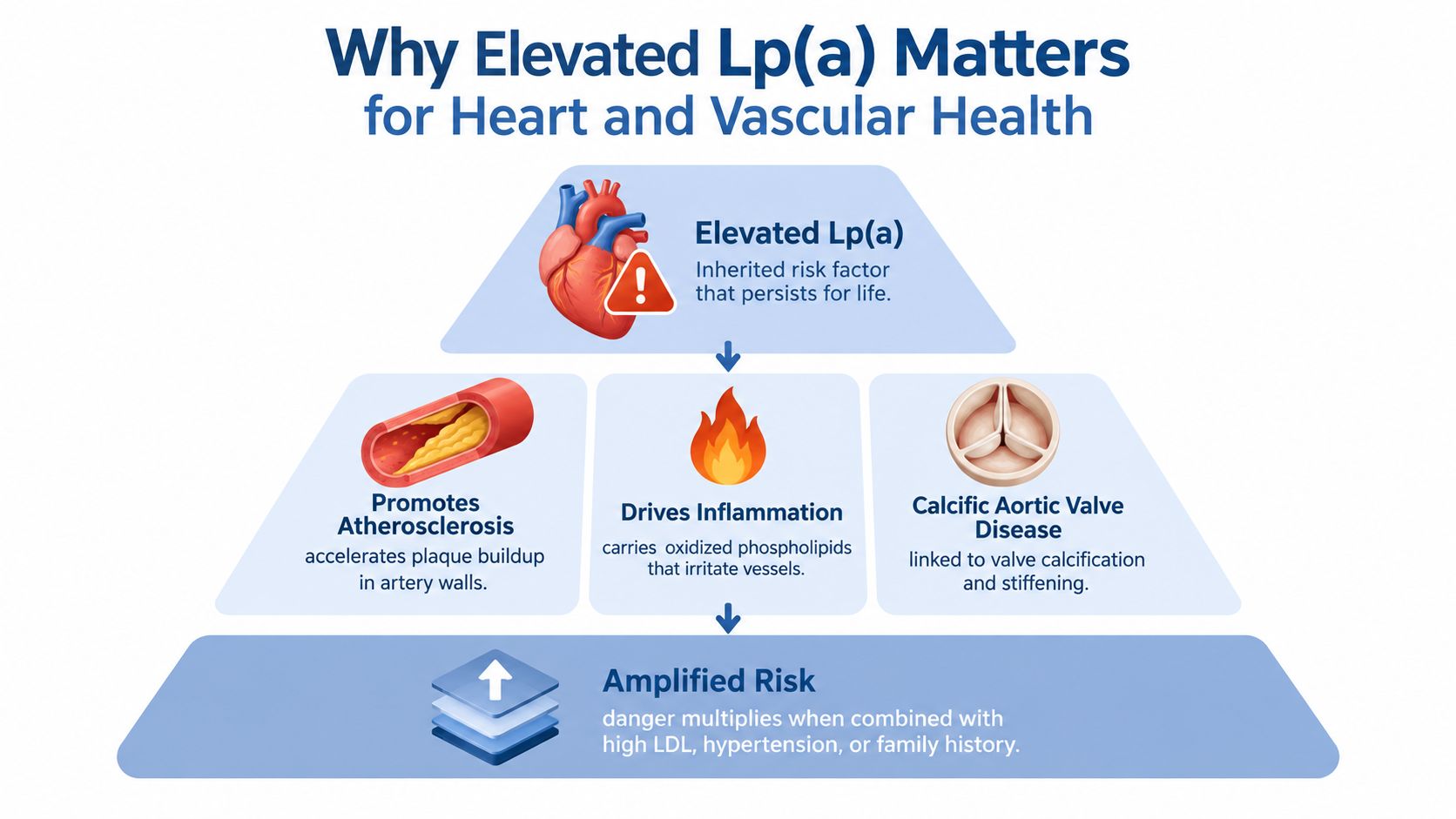
Higher Lp(a) can participate in atherosclerosis, the buildup of plaque inside artery walls. It also carries oxidized phospholipids, which can promote inflammatory activity around blood vessels. Together, these features help explain why standard cholesterol results may not show the full risk picture.
Lp(a) is also associated with calcific aortic valve disease, in which the aortic valve becomes thickened and stiff. The blood test does not diagnose valve disease. It adds context when someone has a murmur, an unusual examination, symptoms, or another reason for cardiac evaluation.
Risk is additive, not isolated
A higher result deserves more attention when it appears alongside other contributors to cardiovascular risk, such as:
- High ApoB or LDL-related particle burden, which may provide more material for plaque formation.
- Hypertension, especially when it remains unrecognized or undertreated.
- A family history of premature ASCVD, which may indicate additional inherited susceptibility.
- Established plaque or vascular disease, identified through appropriate clinical evaluation.
Consider two people with identical LDL cholesterol values. One has a lower Lp(a) level and no family pattern of early disease. The other has markedly high Lp(a), a parent with premature ASCVD, and evidence of subclinical plaque. Their LDL results match, but their prevention discussions should not.
A higher Lp(a) result should sharpen prevention, not create fatalism. It identifies inherited susceptibility, while clinical care still has considerable room to address risks that can be changed.
Professional organizations, including the American Heart Association, the American College of Cardiology, and European cardiovascular societies, increasingly treat Lp(a) as a risk-enhancing factor. That classification does not predict an individual outcome. It supports a fuller assessment when the standard lipid profile leaves important questions unanswered, and it can prompt discussion of testing for close family members who may share the same inherited signal.
How Lp(a) Results Shape Preventive Cardiology Decisions
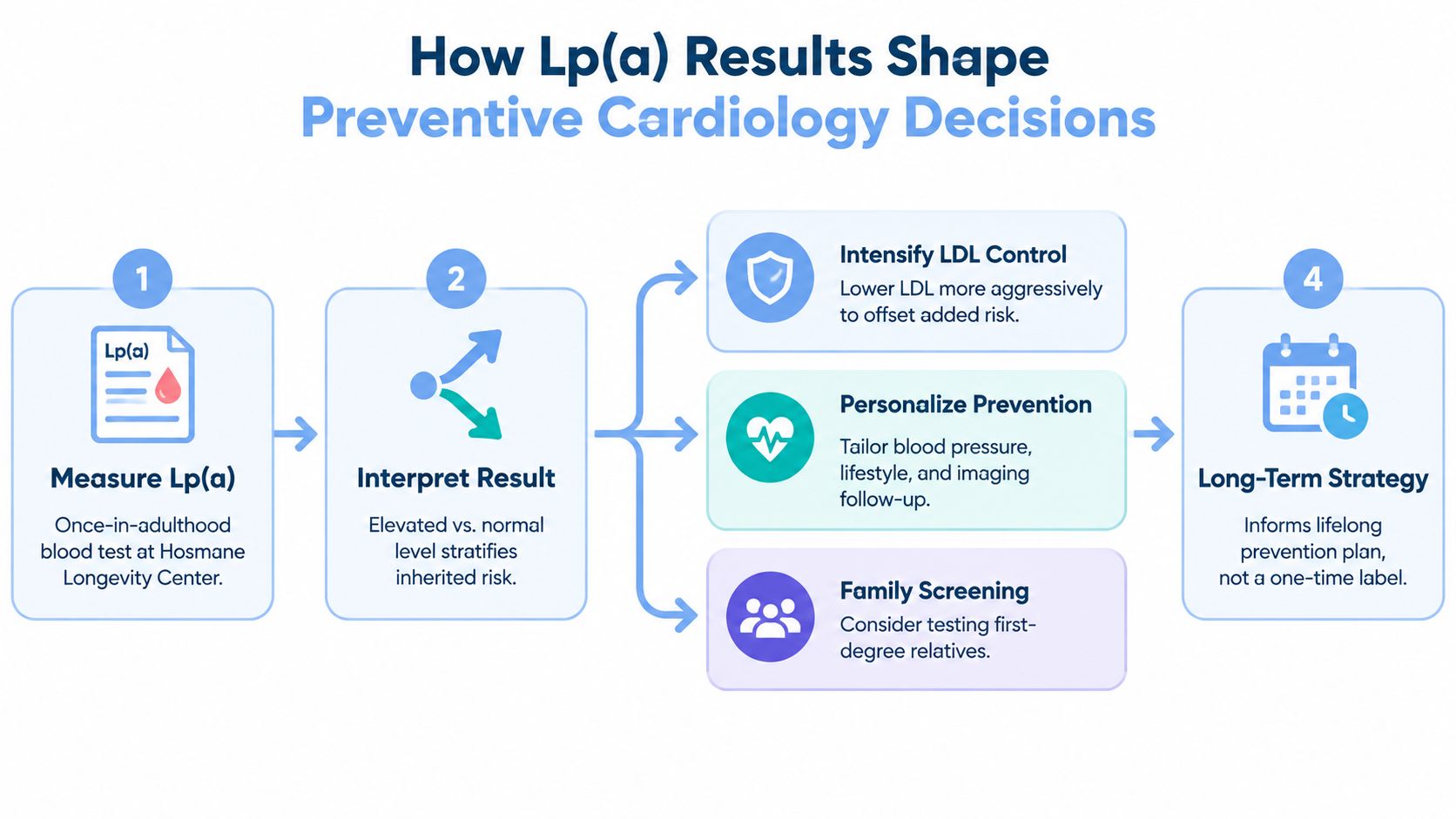
The practical value of an Lp(a) result lies in what it changes. A normal or modest result may provide useful context. A clearly high result can shift a preventive cardiology conversation from general reassurance toward a more deliberate search for subclinical disease and tighter management of modifiable risks.
From result to strategy
A clinician may consider whether advanced cardiac testing could clarify the presence or absence of plaque. Depending on the person's history and examination, that discussion can include Coronary Artery Calcium, carotid intima-media thickness, stress echocardiography, abdominal aortic ultrasound, or ankle-brachial index assessment with exercise. These tests aren't automatic consequences of a high Lp(a), and not every test suits every patient.
The result can also support closer attention to:
- LDL and ApoB control, with treatment intensity matched to the overall risk picture.
- Blood pressure, including out-of-office measurement when readings are uncertain.
- Glucose and metabolic health, especially when other risk factors cluster.
- Exercise and nutrition, designed around the person's schedule rather than an idealized routine.
- Family cascade testing, particularly for first-degree relatives when Lp(a) is high and the family has premature ASCVD or familial hypercholesterolemia.
Why lifestyle still matters
Lifestyle changes generally don't lower the Lp(a) number in a meaningful way, but that doesn't make them irrelevant. Regular physical activity, a heart-supportive eating pattern, healthy sleep, appropriate weight management, and blood pressure control address the broader cardiovascular environment in which inherited risk operates.
The test is therefore not a treatment-response monitor. If an executive changes diet or begins a structured exercise program, a repeat Lp(a) value usually won't show the benefit of that effort. The benefit should be assessed through the overall risk profile and appropriate clinical measures, not by expecting an inherited marker to behave like triglycerides.
At Hosmane Longevity Center, physician-led preventive cardiology can combine advanced biomarkers with imaging, exercise prescription, dietitian planning, and direct interpretation. The purpose is coordination. A busy professional shouldn't have to interpret an isolated result while separately arranging every next step.
Testing Considerations Preparation and When to Retest
For most adults, an Lp(a) blood test is a once-in-adulthood measurement. Recent guidance describes Lp(a) as more than 90% genetically determined and usually stable, which means repeated testing adds little for many people. Broad testing is becoming more common, including for adults who don't fit traditional high-risk categories, because inherited risk can remain hidden when routine cholesterol results look acceptable.
Before the blood draw
Lp(a) generally doesn't require special preparation or fasting. It can often be collected alongside other lipid and metabolic testing, but the ordering clinician should explain whether any other tests in the same visit do require preparation.
A useful pre-test checklist includes:
- Bring the complete report, including units and laboratory reference ranges.
- Document family history, especially early heart attack, stroke, peripheral artery disease, or known high Lp(a).
- Ask which assay reported the result, particularly if prior and current values appear inconsistent.
- Avoid online unit conversion, since apo(a) isoform size makes simple conversion unreliable.
Testing of advanced lipid and inflammatory biomarkers, including Lp(a) and ApoB, is available in Lewes and Wilmington without a referral and without Executive Health Program enrollment. Details about available testing can be found through advanced cardiac testing services.
When another measurement may help
Repeat testing isn't routine, but several situations can justify a clinician-led discussion:
- A borderline value, when the result sits near a threshold that could change management.
- After menopause, particularly for a woman whose earlier pre-menopausal value was near a decision boundary.
- Kidney disease, which can complicate interpretation and clinical risk assessment.
- A new therapy, when the clinician needs to understand whether a treatment could affect the marker.
- A result that seems inconsistent, especially when units, laboratory methods, or clinical circumstances differ.
Pregnancy and testing during childhood may also require separate interpretation. The central question isn't “How often should the number be checked?” It's whether a new measurement is likely to resolve a genuine clinical uncertainty.
The useful test is the one that changes a decision. Repeating a stable inherited marker simply to create another data point can add confusion rather than clarity.
Next Steps Toward Personalized Heart Risk Clarity
Lp(a) is best understood as a largely inherited and usually stable risk signal, not another cholesterol value to track after every lifestyle change. Nmol/L is generally preferred because it reflects particle concentration, while mg/dL reflects mass and shouldn't be converted casually. Thresholds around 125 nmol/L or 50 mg/dL can indicate increased risk, and values around 250 nmol/L or 100 mg/dL represent a substantially higher-risk range, always interpreted with the full clinical picture.
A high result doesn't predict an individual future with certainty. It can, however, support earlier consideration of vascular imaging, more exacting control of modifiable risks, and testing for first-degree relatives. That combination turns inherited information into a practical prevention strategy.
Dr. Vinay Hosmane leads preventive cardiology at Hosmane Longevity Center, where advanced cardiac testing and direct physician interpretation can be coordinated for professionals who want a coherent plan. The Executive Health Program is one pathway, while testing is also available to people who aren't program members.
Hosmane Longevity Center offers Lp(a) and ApoB testing, advanced cardiac evaluation, and cardiologist-guided preventive planning in Lewes and Wilmington for adults seeking clearer cardiovascular risk assessment. Professionals in Delaware, Pennsylvania, and Maryland can visit Hosmane Longevity Center to request a consultation and discuss how an Lp(a) result should be interpreted alongside family history, imaging, and the rest of the cardiovascular profile.