
A chief executive in Wilmington finishes a routine physical with a reassuring LDL-C result, an automated blood-pressure reading, and a recommendation to return next year. A separate appointment in Lewes produces an ECG, while a family physician in Pennsylvania has the family history and a previous lab report. None of the clinicians has had enough time to connect the findings. The result isn't necessarily poor care. It's fragmented care, with important decisions left unresolved.
That gap explains the interest in a concierge cardiology practice among busy professionals in Delaware, nearby Pennsylvania, and Maryland. The model can provide more time, more direct physician involvement, and a deliberate framework for deciding whether advanced cardiac testing will change management. It can also add cost without proving better outcomes for every patient.
The useful question isn't whether concierge care sounds premium. It's whether a smaller patient panel and high-touch follow-through help identify hidden cardiovascular risk, interpret it correctly, and turn the findings into sustainable action. The discussion below applies the principles of AHA, ACC, and ESC guidance in plain language, without promises or individualized medical advice.
Table of Contents
- Introduction to Concierge Cardiology for Busy Professionals
- What a Concierge Cardiology Practice Is and How It Works
- Concierge Cardiology vs Traditional Practice Models Compared
- Advanced Cardiac Testing and Preventive Cardiology Explained
- Costs Access and Benefits of Membership Based Cardiac Care
- Who Benefits Most and Real World Use Cases for Executives
- How to Choose the Right Model and Schedule Your Consultation
Introduction to Concierge Cardiology for Busy Professionals
For professionals between 40 and 65, cardiovascular prevention often competes with travel, board meetings, business meals, caregiving, and interrupted sleep. A person may know that a parent had premature heart disease or that blood pressure has been borderline, yet still lack a single clinician who reviews the full pattern. Standard cholesterol testing may look acceptable while other risk markers remain unexplored.
Concierge cardiology emerged in the late 1990s partly in response to dissatisfaction with short, fragmented primary-care visits. By 2005, it remained a small specialty niche, with fewer than 300 practices nationwide, according to a 2005 JACC commentary and subsequent industry reporting. Later reporting described about 5,000 concierge practices and roughly 7,500 physicians in the United States, while specialists represented under 10% and only about 25 physicians self-identified as concierge cardiologists in 2015, according to the same source.
This history matters because concierge cardiology isn't traditional cardiology delivered with a luxury label. It's a relatively recent, established offshoot of the broader membership model, generally built around fewer patients, faster communication, longer visits, and direct physician interpretation.
The central distinction: A scan has limited value if nobody explains what it means, what it changes, and how the patient will act on it.
The comparison ahead focuses on five decisions: how quickly a patient can be evaluated, how much time the physician has, which tests are appropriate, who integrates the results, and whether follow-through fits real working life. Advanced testing can also be available to people who aren't program members, depending on the practice and service.
What a Concierge Cardiology Practice Is and How It Works
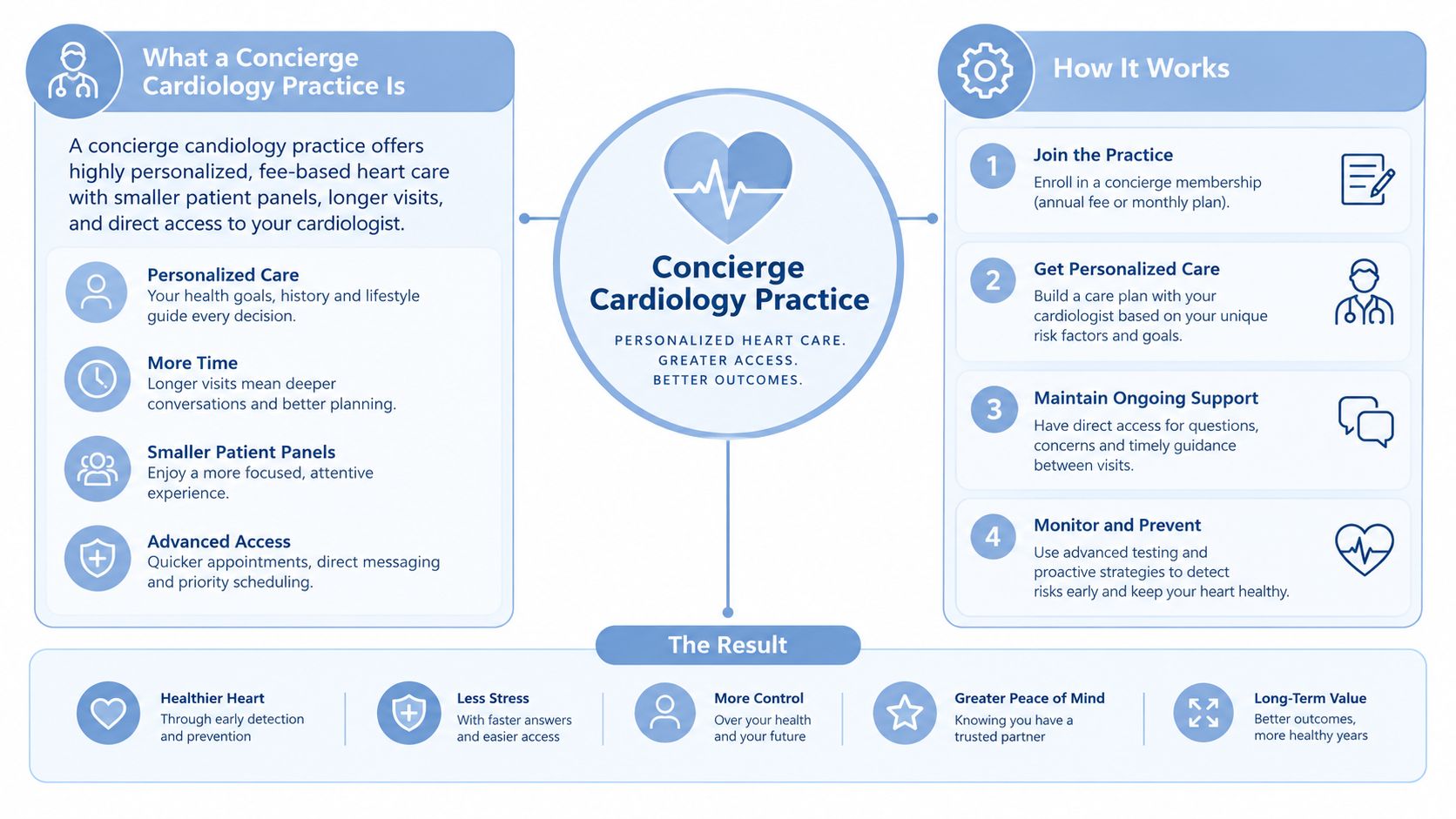
A concierge cardiology practice usually combines a membership or retainer fee with a smaller patient panel. In exchange, the practice may offer longer appointments, more direct communication, coordinated testing, and proactive follow-up. The fee generally covers physician access and care coordination, while certain imaging, laboratory, or hospital services may involve separate charges.
The operating model
The structure usually works through a sequence:
Intake: The cardiologist reviews symptoms, family history, medications, blood pressure patterns, sleep, exercise, nutrition, and prior testing rather than treating one isolated lab value.
Risk definition: The clinician decides whether the patient needs standard prevention, more detailed risk reclassification, symptom evaluation, or monitoring.
Selective testing: Tests such as CAC imaging, ApoB, Lp(a), stress echocardiography, ABI, ambulatory blood-pressure monitoring, or a home sleep study are chosen for a clinical reason, not because they're available.
Interpretation and prioritization: The physician explains which findings matter now, which can be monitored, and which don't justify escalation.
Follow-through: The care team revisits medication tolerance, exercise, nutrition, sleep, and adherence as circumstances change.
Hosmane Longevity Center is a physician-led preventive cardiology and executive health program in Lewes and Wilmington. Its Core Cardiovascular Assessment combines cardiovascular testing, risk modeling, physician interpretation, and coordinated support from professionals such as a registered dietitian, physical therapist, cardiovascular sonographer, and health coach. Care is cash-pay, no referral is required, and in-person visits are available in Lewes and Wilmington, subject to the practice's coverage and enrollment limitations.
What the fee does and doesn't mean
A membership doesn't guarantee prevention, eliminate the need for emergency care, or replace hospital-based cardiology when acute symptoms occur. It also doesn't make every advanced test appropriate. The clinical value comes from matching the question to the test and then making a defensible decision from the result.
A traditional cardiology practice can provide excellent diagnosis and treatment, especially for symptoms, known disease, procedures, and hospital follow-up. Concierge care changes the delivery model. Its practical promise is more continuity and physician time, not immunity from cardiovascular risk.
Concierge Cardiology vs Traditional Practice Models Compared
The meaningful comparison isn't “luxury” versus “ordinary.” It's high-touch continuity versus episodic access, with important variation inside both models.
| Criteria | Concierge Cardiology Practice | Traditional Practice Model |
|---|---|---|
| Access | Often includes direct communication and faster scheduling within the practice model | Scheduling follows panel volume, referral pathways, and appointment availability |
| Visit time | Smaller panels can support longer, more focused encounters | Visit length is commonly shaped by clinic volume and appointment templates |
| Continuity | A designated physician and coordinated team may follow the patient across decisions | Care may involve primary care, general cardiology, imaging, and laboratories separately |
| Testing strategy | Advanced testing is selected within a preventive risk framework | Testing is often ordered for symptoms, established disease, or standard risk assessment |
| Interpretation | Physician-led review can connect imaging, biomarkers, history, and behavior | Results may be distributed across clinicians, portals, and separate appointments |
| Follow-through | Ongoing communication can support medication, exercise, nutrition, and monitoring plans | Follow-up depends on appointments, referrals, and the patient's ability to coordinate care |
| Cost structure | Usually includes a membership or retainer, with possible separate testing costs | Typically uses insurance-based visits and testing, subject to coverage and cost sharing |
Access and time
A smaller panel can make it easier to reach the physician, arrange a follow-up, or discuss a new result without waiting for a routine appointment. That can matter to an executive who spends weeks traveling or who needs a prevention plan that accommodates business meals and irregular schedules.
Traditional care remains appropriate for many people. Primary care can manage common risk factors, provide routine screening, and coordinate referrals. General cardiology is essential for symptoms, abnormal tests, known cardiovascular disease, and treatment decisions that require specialty expertise.
Testing and interpretation
A concierge model may offer broader access to testing, but more testing isn't automatically better. CAC can help resolve uncertainty about statin treatment in selected asymptomatic adults. ApoB or Lp(a) can reveal information that standard LDL-C doesn't fully capture. A stress echocardiogram or ambulatory monitor answers a different question, particularly when symptoms or rhythm concerns exist.
The decisive step is interpretation. A clinician must connect the result to age, risk factors, family history, symptoms, treatment tolerance, and patient preferences. Without that context, a normal result can create false reassurance, while an abnormal result can trigger anxiety or unnecessary testing.
Practical rule: Choose the model that can answer, “What changes because of this finding?” before ordering the test.
Lifestyle support and continuity
Prevention often fails between appointments, not during them. An individualized exercise prescription, registered dietitian review, sleep assessment, and coaching can help a plan survive travel and demanding work. Traditional practices may offer these services through referrals, while a concierge team may coordinate them under one plan.
Neither model guarantees adherence or outcomes. The right choice depends on clinical complexity, access needs, financial priorities, and the patient's preference for a coordinated relationship.
Advanced Cardiac Testing and Preventive Cardiology Explained
A busy executive may have a normal office visit and a standard lipid panel, yet still face uncertainty about inherited risk or early plaque. Preventive cardiology uses targeted testing to answer those specific questions. The goal is to identify a finding that changes treatment, monitoring, family screening, or behavior, rather than accumulate an impressive stack of reports.
CAC and subclinical atherosclerosis
CAC scoring measures calcified plaque in the coronary arteries. A CAC score of 0 can support withholding or delaying statin therapy in many adults when the decision is uncertain. The 2018 AHA/ACC cholesterol guideline identifies important exceptions, including cigarette smoking, diabetes, and a strong family history of premature ASCVD.
The same guideline states that a score of 1–99 generally favors statin therapy, particularly at age 55 or older. A score of 100 or higher, or a score at or above the 75th percentile, indicates statin therapy unless clinician-patient discussion leads otherwise. CAC is most useful for asymptomatic adults in primary prevention with borderline or intermediate estimated risk, approximately 5% to 20%, when the treatment decision remains uncertain, according to a guideline-based prevention review.
CAC answers a plaque question. It does not diagnose every form of heart disease or replace urgent evaluation of chest pain, shortness of breath, fainting, or other concerning symptoms.
ApoB, Lp(a), and residual risk
LDL-C measures cholesterol carried in LDL particles, but it may not represent the total burden of atherogenic particles. ApoB can refine risk when LDL-C appears controlled but the broader pattern includes metabolic risk, high triglycerides, diabetes, or discordance between cholesterol and particle burden.
Lp(a) is largely genetically determined and is treated as a causal risk factor in contemporary consensus guidance. The 2022 European Atherosclerosis Society consensus00182-X/fulltext) gives pragmatic thresholds of less than 30 mg/dL or less than 75 nmol/L to help rule out risk, and greater than 50 mg/dL or greater than 125 nmol/L to help rule in higher risk. Units are not interchangeable, so results require careful interpretation.
Recent guidance supports at least once-in-a-lifetime Lp(a) testing and selective ApoB testing. A 2025 meta-analysis summarized in recent ACC guidance found that high Lp(a) was associated with higher CAC prevalence, with an odds ratio of 1.31 and a 95% confidence interval of 1.06 to 1.61. That association does not assign one treatment to every person with high Lp(a). Family history, CAC, ApoB, LDL-C, and other risks still require an integrated review. A high result may also support family screening.
Other tests and the decision they serve
A preventive evaluation may consider:
- CIMT and vascular ultrasound: These provide structural information, but usefulness depends on the clinical question and interpretation quality.
- Stress echocardiography: This evaluates cardiac response to stress and may suit selected symptoms or functional questions.
- ABI with exercise: This assesses lower-extremity arterial circulation when peripheral vascular disease is a concern.
- ECG and ambulatory telemetry: These examine rhythm and conduction when palpitations, fainting, or intermittent symptoms require correlation.
- Twenty-four-hour blood-pressure monitoring: This clarifies blood-pressure patterns that office readings may miss.
- Home sleep study: Sleep-disordered breathing can affect blood pressure, rhythm, and cardiometabolic health when the history supports evaluation.
Repeat CAC depends on the original score, risk trajectory, age, treatment decisions, and clinician judgment. The prevention literature notes that repeat testing can be considered after about 5 years when the initial score is 0 or 1–99. A high Lp(a) result usually increases attention to risk-factor management and family screening, while many Lp(a)-specific management choices remain under study.
Patients can review advanced cardiac testing options before a consultation and bring focused questions. High-touch care matters most when it connects the result to a clear plan, tracks whether that plan is followed, and revisits treatment as risk changes.
Costs Access and Benefits of Membership Based Cardiac Care
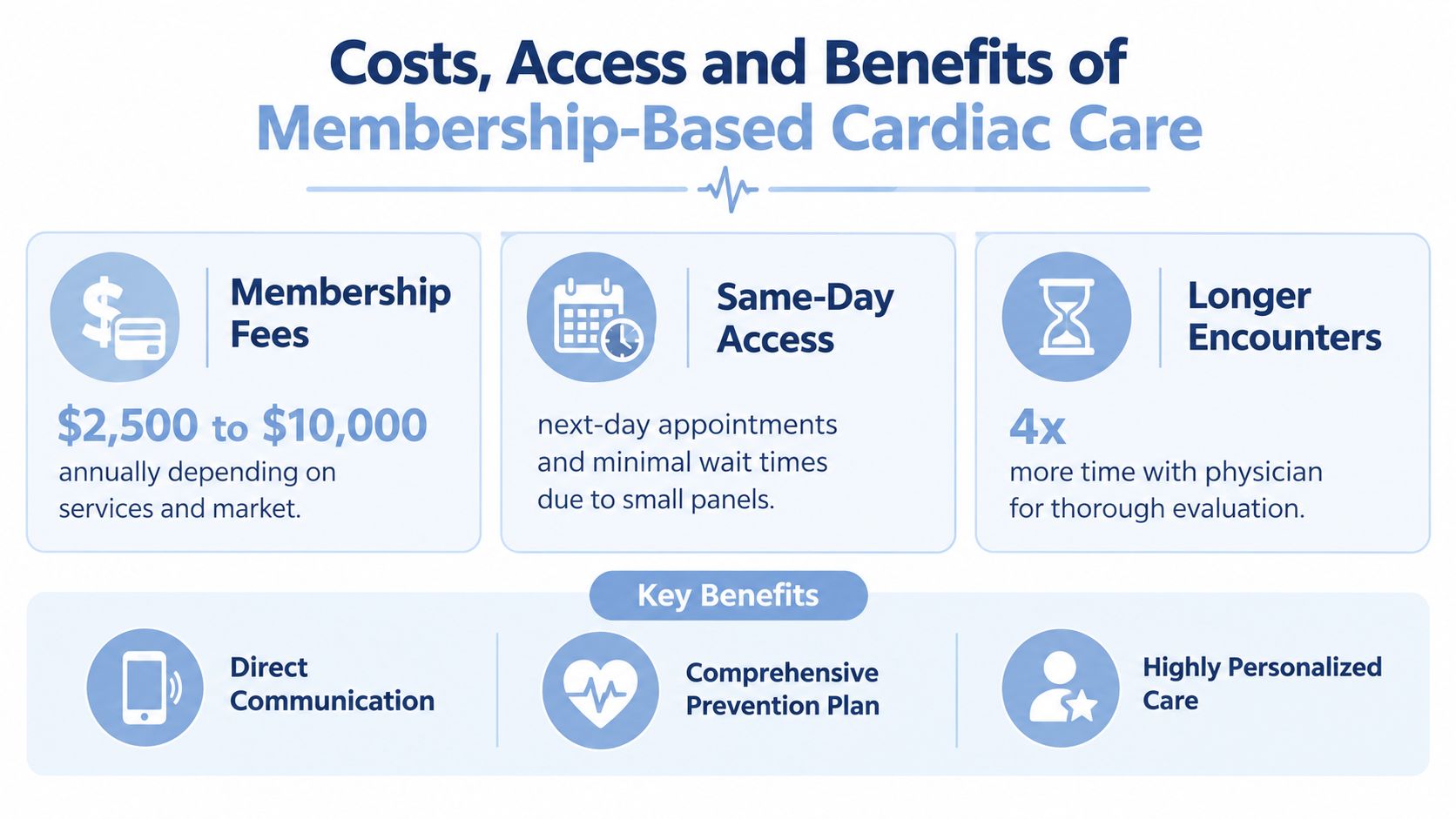
A busy professional with a strong family history may receive normal routine results yet still face unanswered questions about residual cardiovascular risk. Membership-based care charges directly for more physician time, communication, and coordination. Harvard Health describes concierge fees ranging from several hundred to tens of thousands of dollars per year, while smaller patient panels may support same-day or next-day visits and longer encounters, as discussed in Harvard's overview of concierge medicine and direct primary care.
The financial decision has two parts. Can the household absorb the membership fee and any testing costs? Does the patient value integrated interpretation and reliable follow-through enough to pay outside standard insurance arrangements?
What patients are buying
A membership may provide:
- Access: More direct communication and scheduling flexibility.
- Time: Longer visits to discuss family history, medication concerns, travel, sleep, and work constraints.
- Coordination: Fewer disconnected handoffs among testing, interpretation, nutrition, exercise, and follow-up.
- Accountability: Planned reassessment when a treatment or lifestyle change becomes difficult to maintain.
For an executive, that structure can turn scattered appointments into a defined decision process. The value is not the number of scans. It is knowing whether CAC, ApoB, or Lp(a) changes management, then making sure the resulting plan is followed. These services do not guarantee a clinical outcome.
What the evidence says about spending
Patients should not assume concierge medicine lowers total healthcare spending. A health-economics study summarized in Penn LDI's review found that, after switching to concierge medicine, total spending was more than 25% higher after one year and up to 50% higher overall, with no measurable mortality improvement.
That result does not determine whether concierge cardiology is worthwhile for a particular patient. It sets a financial benchmark. The model should be judged by whether it clarifies residual risk, strengthens risk-factor treatment, and improves follow-through, rather than presented as a cheaper route to care or a guarantee of longer life.
Before joining, ask what the fee includes, which tests cost extra, how urgent concerns are handled, and how insurance applies to outside services. Details about a cardiovascular executive health program can help organize that discussion.
Who Benefits Most and Real World Use Cases for Executives
Concierge cardiology is most useful when a busy professional faces an unresolved risk question, fragmented care, or difficulty carrying out a prevention plan. It is a clinical coordination model, not an automatic requirement for every healthy adult.

The time-constrained executive
A Wilmington executive may have normal routine labs alongside inconsistent sleep, limited exercise, frequent travel, and repeated borderline blood-pressure readings. The next step should connect the finding to a decision. That may involve a detailed history, home or ambulatory blood-pressure review, sleep evaluation, exercise assessment, and selective advanced lipid testing.
A practical program can include an exercise prescription, dietitian-led nutrition, and coaching adapted to travel and business meals. Its value depends on execution and continuity. The plan should be revisited when work demands, sleep, weight, or blood pressure changes.
The family-history patient
A professional with premature ASCVD in the family may need more than reassurance from an acceptable LDL-C. Lp(a), selective ApoB testing, and review of affected relatives can identify inherited risk that a standard lipid panel may not show.
For this patient, a single lifetime Lp(a) result can determine whether screening relatives is appropriate, a step an LDL-C result alone would not trigger. A high value may justify earlier attention to overall risk and more deliberate treatment decisions. It does not dictate one universal therapy, particularly because management options and evidence remain individualized.
The broader question is whether the result changes action. A concierge visit can connect the laboratory finding with family counseling, documentation, and follow-through rather than leaving it as an isolated number.
The asymptomatic patient with uncertain risk
An asymptomatic adult may have a treatment decision that remains unclear after reviewing traditional risk factors. CAC can show whether coronary calcification is present. A zero score may support deferral in selected circumstances, while detectable or substantial calcium can favor more active risk reduction. Diabetes, smoking, family history, symptoms, and the full clinical context still matter.
Extra testing is not automatically better prevention. Before paying for a scan or panel, ask which result would change management now and which would only add information. That question helps distinguish a useful decision tool from low-value testing, while keeping attention on the follow-through that turns risk assessment into care.
How to Choose the Right Model and Schedule Your Consultation
A traditional primary-care or cardiology model may fit a patient who has reliable access, straightforward risk factors, and no need for extensive coordination. A concierge cardiology practice may fit someone who values longer visits, direct physician communication, integrated testing, and structured follow-through.
A practical checklist can clarify the choice:
- Clinical question: Is there a symptom, abnormal test, family history, or residual-risk concern that needs specialist interpretation?
- Access requirement: Does travel or workload make routine scheduling and fragmented referrals difficult?
- Testing purpose: Can CAC, ApoB, Lp(a), monitoring, or another test answer a defined management question?
- Financial fit: Are membership and separate testing costs understood and acceptable?
- Continuity preference: Does the patient want one clinician and team to track decisions over time?
Advanced cardiac testing can be available to anyone, not only program members, depending on the service and practice arrangement. The Hosmane Longevity Center team provides information about physician-led preventive cardiology and executive health care in Lewes and Wilmington.
This article is educational and doesn't provide individualized medical advice. Symptoms, test results, medications, and family history should be reviewed with a qualified clinician, and urgent symptoms require appropriate immediate care.
Hosmane Longevity Center offers physician-led preventive cardiology, advanced cardiac testing, risk modeling, and coordinated lifestyle support for professionals seeking a clearer approach to hidden cardiovascular risk. Visit Hosmane Longevity Center to learn more and schedule a consultation with Dr. Vinay Hosmane about an evidence-based prevention plan.